

Imagine you had a private meeting with Warren Buffett. You might expect him to begin by asking about your stocks, your portfolio performance, or where you think the economy is headed next. But if you study Buffett’s approach to wealth long enough, you begin to realize that probably is not where he would start.
If Warren Buffett reviewed your portfolio, he would likely begin with a much more important question: How much income does your life actually require? That question may provide useful context when evaluating a financial plan. Until you understand the income your lifestyle requires, it is difficult to know whether your portfolio is truly positioned well. A strong return may not help much if your financial life needs everything to go right. A sophisticated allocation may still feel fragile if one difficult year creates real pressure.
In this episode of Retirement Blueprint, I want to look at what Buffett’s mindset can teach us about retirement income planning, portfolio discipline, simplicity, patience, and the kind of financial structure that allows wealth to last.
Listen on


View the full transcript of this episode here.
The First Question Is Not About the Portfolio
Most investors assume a portfolio review should begin with questions about investments. What stocks do you own? What return are you earning? Are you taking too many risks? Should your allocation change based on today’s market conditions? Those are fair questions, and they do matter. But they are not usually the first questions that should be asked. Before you can judge whether a portfolio is appropriate, you have to understand the job that portfolio is being asked to do. Is it meant to support retirement income, replace business distributions, provide security for a spouse, fund family support, create legacy wealth, or provide liquidity during a future transition?
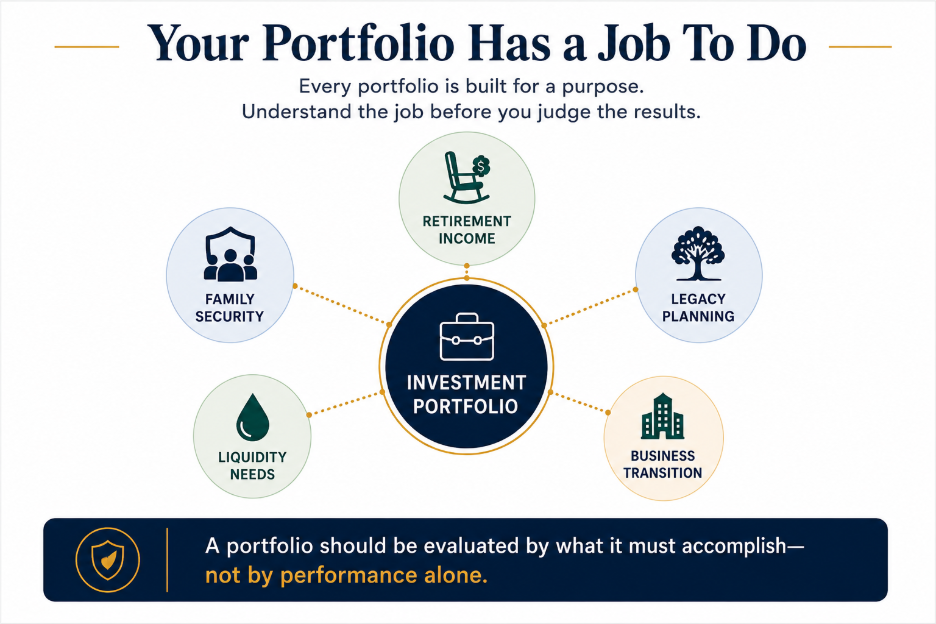 Illustrative purposes only. Portfolio objectives and priorities vary by investor. No investment strategy can guarantee the achievement of any stated objective or goal.
Those are different responsibilities, and they require different structures. That is why required income matters. Required income is the amount your life needs from your earnings, business, retirement accounts, or investment portfolio in order to function. It includes the obvious expenses, but it also includes the commitments that often come with success: homes, taxes, insurance, healthcare, travel, giving, family support, and long-term obligations.
None of those things are automatically wrong. Many may reflect the values, generosity, and priorities of a family that has worked hard and wants to enjoy what has been built. The issue is not whether you should enjoy your wealth. The issue is whether the financial structure underneath that life has enough room to withstand uncertainty. Two families can have the same net worth and feel completely different. One may have margin, flexibility, and the ability to wait through volatility. The other may have the same amount of wealth on paper but far more pressure because their lifestyle requires strong income, strong markets, and very little disruption. That difference may matter more than last year’s investment return.
Buffett’s Real Advantage Was Temperament
Buffett’s greatest advantage was not simply intelligence. It was a temperament. He understood that money is emotional before it is mathematical, and he structured his life in a way that made patience possible. His lifestyle was modest, relative to his wealth. His obligations were manageable. His time horizon was long. He did not appear overly concerned with impressing others. That structure gave him room to wait. And in investing, the ability to wait is often one of the most valuable advantages a person can have.
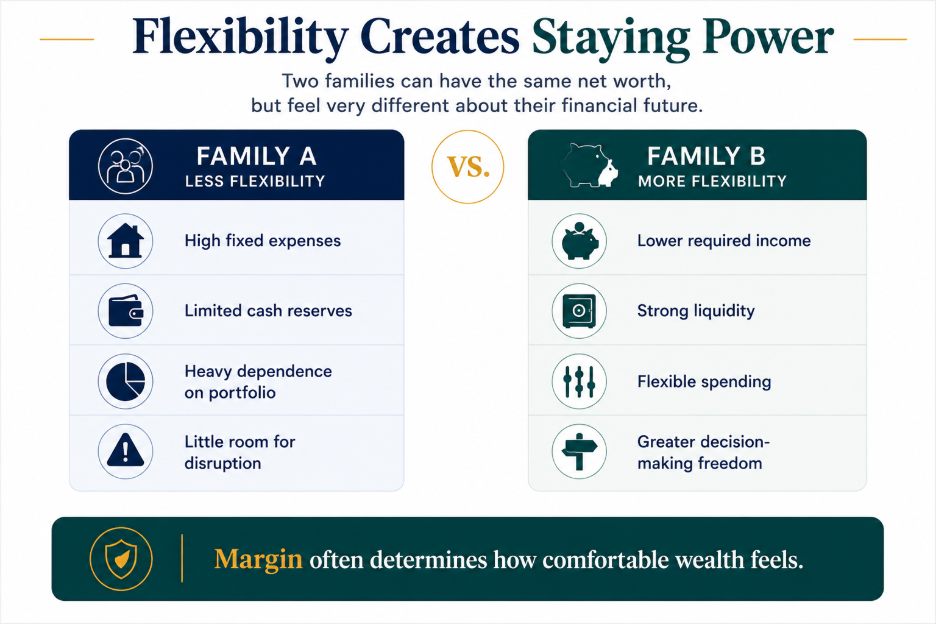 Illustrative purposes only. This graphic is intended to demonstrate general financial planning concepts and is not a prediction of outcomes or a guarantee of future financial or investment results.
Most investors admire patience, but very few build a financial life that actually supports it. Patience is easy when markets are rising, income is steady, and everything feels orderly. It becomes much harder when the market falls; expenses rise, business slows, or someone else appears to be getting rich faster. In those moments, even intelligent people can make decisions they later regret.
This is where many successful families get into trouble. They are not careless. In many cases, they are disciplined, driven, and financially aware. But over time, more accounts, more commitments, more tax decisions, and more family responsibilities can turn the portfolio into the thing that has to hold everything together. That is a heavy burden for any investment plan to carry out.
When Complexity Is Really Anxiety
I once worked with a client who looked very sophisticated from the outside. He had multiple accounts, frequent strategy changes, and constant adjustments to his financial plan. At first glance, it appeared diligent. Underneath, much of it was anxiety. The problem was not really the portfolio. It was the life attached to the portfolio. His spending required everything to go right. His income needed to stay high. The markets had to cooperate. His financial life had very little room for interruption, which meant every decision felt urgent, and every market movement felt personal. That is not investing with discipline. That is hoping the environment will keep cooperating.
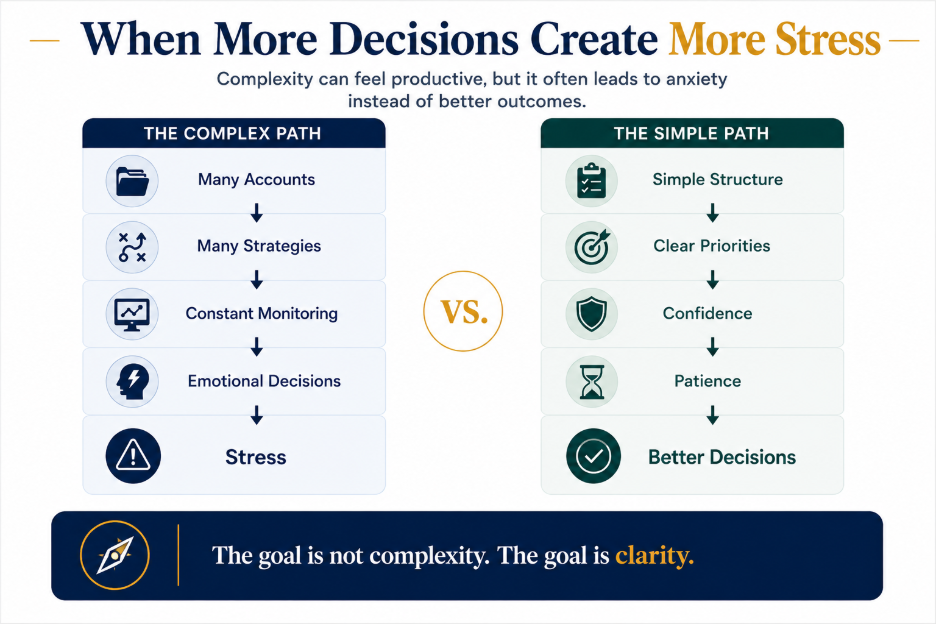 Illustrative purposes only. This graphic is intended to demonstrate general financial planning concepts and is not a prediction of outcomes or a guarantee of future financial or investment results.
The question that changed the conversation was simple: What if the goal is not to maximize returns, but to minimize regret? That does not mean returns are unimportant. It means returns are not the only measure of whether a financial plan is working. A plan that produces strong performance but leaves a family anxious, overextended, and exposed may not be fulfilling its purpose. Once we reduced complexity, lowered fixed expenses, and aligned the portfolio with his actual life, the pressure began to come out of the system. Returns still mattered, but they mattered less because the plan no longer depended on extraordinary outcomes. He had more room to think clearly, remain patient, and make decisions from confidence rather than stress.
Investing Is Simple, But Not Easy
Buffett has often said that investing is simple, but not easy. That distinction is important. The concepts behind durable wealth are usually not complicated. Spend less than your life can reasonably support. Diversify. Maintain liquidity. Avoid unnecessary debt. Do not let taxes drive every decision. Give compounding enough time to work. Most successful families understand those ideas.
The challenge is behavior. Fear can make people sell at the wrong time. Envy can make them chase what recently worked. Overconfidence can cause them to concentrate on risk. Constant access to information can create the illusion that constant action is necessary. Many investors do not fail because they lack intelligence. They fail because they abandon good plans at exactly the wrong time. That is why a strong financial plan should reduce pressure before pressure arrives. It should build in liquidity, flexibility, and enough margin that one difficult season does not threaten the whole plan. The best time to decide how much income your portfolio must support is not after retirement begins. The best time to prepare for volatility is not when markets are already falling. Those decisions deserve structure before they become urgent.
Build a Life That Does Not Require Extraordinary Returns
If there is one principle that captures the Buffett mindset, it may be this: Build a life that does not require extraordinary returns. That idea may help some investors think differently about balancing spending, risk, and long-term planning. If your life works with average returns, you are in a strong position. You can be patient. You can let time work. You can avoid chasing trends. You can make decisions calmly because the plan does not require perfection.
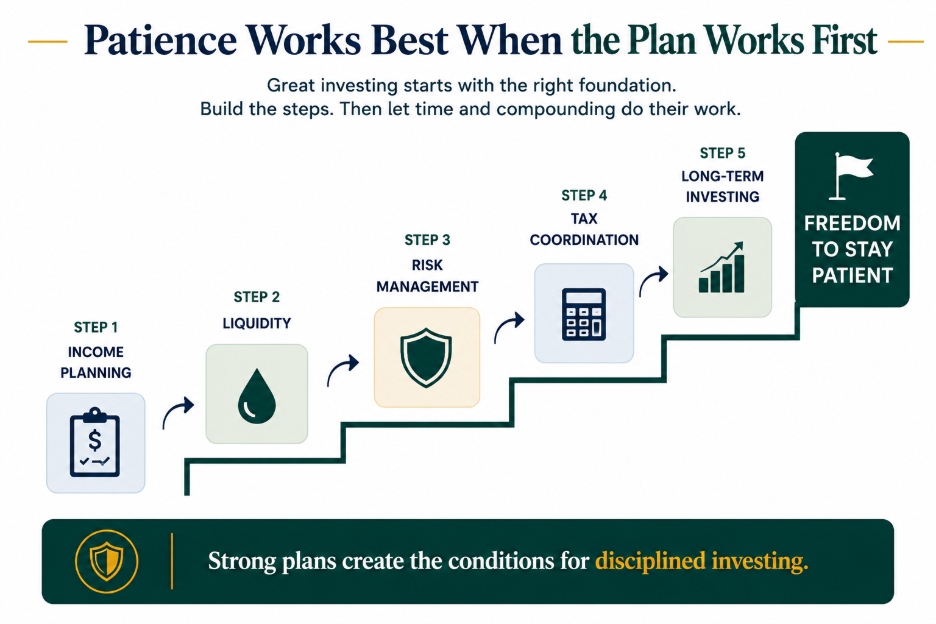 Illustrative purposes only. This graphic is intended to demonstrate general financial planning concepts and is not a prediction of outcomes or a guarantee of future financial or investment results.
But if your life only works when the portfolio performs exceptionally well, the plan may be more fragile than it appears. Strong markets can hide that fragility for years. Rising income can cover it. Business growth can delay it. But eventually, every financial plan meets a season where returns are lower, expenses are higher, taxes are less convenient, or life changes faster than expected.
A durable plan does not remove uncertainty; it prepares for it. That may mean reducing fixed expenses before retirement, building cash reserves, diversifying concentrated positions, or simplifying accounts so your spouse or family can understand the plan. It may mean accepting that the best portfolio is not always the most interesting one, but the one most capable of supporting the life you actually want.
Applying the Buffett Mindset to Your Retirement Plan
Thinking more like Buffett does not require copying his investments. It requires adopting his discipline. Start by identifying your real required income. Not what you hope you spend, and not what you think you should spend, but the actual number your life requires. Then separate what is fixed from what is flexible. This is often where families gain the most clarity. Some expenses can adjust if conditions change. Others cannot. The more fixed obligations your life carries, the more important it becomes to build margin into the plan. From there, look at whether your portfolio is aligned with those needs. Does it provide enough liquidity? Is the risk level appropriate for the income it must support? Are tax decisions coordinated with withdrawal planning? Are accounts organized clearly enough that another family member could understand them if necessary?
Finally, reduce complexity where complexity is not serving a clear purpose. Not every account needs a unique strategy. Not every market event requires a response. Not every financial idea deserves implementation. For many successful families, the next best step is not doing more. It is making the financial life more coherent. That is often where confidence begins.
Final Takeaway
This Retirement Blueprint episode is not about idolizing Warren Buffett or pretending every family should invest the same way. It is about learning from a principle that has served disciplined investors for generations: structure your financial life, so patience is possible.
Here is what changed: your financial life may have become more complex. Here is what did not change: lasting wealth still depends on margin, discipline, patience, and thoughtful stewardship. Here is what it means for you: the first step in improving your portfolio may not be finding a better investment. It may be understanding how much your life requires and whether your financial structure can support that life without depending on extraordinary returns. If you have built success but still feel uneasy about money, the issue may not be that you are doing too little. It may be that your financial life is not fully aligned yet. Your portfolio, spending, taxes, income needs, risk exposure, retirement timeline, and family responsibilities all need to work together. When they do not, even meaningful wealth can feel uncertain. When they do, decisions often become calmer, clearer, and more durable.
At GDS Wealth Management, we help high-income professionals, executives, business owners, and families organize the full picture of their financial lives, including retirement income, investment strategy, tax-aware withdrawals, risk management, and estate and legacy planning. If you are wondering whether your portfolio is truly aligned with the life you want to live, schedule a complimentary consultation with our team.
For more retirement planning insights, connect with us on LinkedIn and subscribe to the GDS Wealth Management YouTube channel.
GDS Wealth Management ("GDS") is an SEC-registered investment adviser. Registration does not imply a certain level of skill or training. This material is provided for informational and educational purposes only and should not be construed as investment, tax, or legal advice. The views and opinions expressed are those of the author as of the date published and are subject to change. Any examples are hypothetical and provided for illustrative purposes only. Investing involves risk, including the possible loss of principal. Past performance does not guarantee future results. For additional information regarding GDS, including our services, fees, and conflicts of interest, please review our Form ADV, available upon request or at www.adviserinfo.sec.gov.
