
Turn on the news or scroll through headlines, and you will almost always see some variation of the same message: Social Security is going broke, benefits could disappear, or the system will not be there when you retire. It is not surprising that this creates anxiety. For individuals who have spent decades working, contributing, and planning for retirement, the idea that Social Security might vanish feels deeply unsettling.
This raises an important and very practical question: Can you actually rely on Social Security as part of your retirement income?
We recently covered this topic in a Retirement Blueprint episode, where we break down what is really happening behind the headlines and what it means for your long-term financial plan. If you have not watched it yet, it provides helpful context before diving deeper into the planning side of the conversation:
Listen on

View the full transcript of this episode here.
The reality is that strong retirement planning is not built on predictions about headlines or policy changes. It is built on preparation and the ability to adapt.
Will Social Security Still Exist When I Retire?
One of the most common concerns people have is whether Social Security will still exist by the time they retire. Despite what many headlines suggest, Social Security is not disappearing. The confusion typically stems from discussions around the Social Security Trust Fund and projections about its long-term sustainability.
The Trust Fund has been used to supplement benefits during periods when payouts exceed payroll tax income. According to the latest Social Security Trustees Report, current projections indicate that this reserve could be depleted sometime in the mid-2030s. While that may sound alarming at first, it is important to understand what this actually means in practice.
Even if the Trust Fund is depleted, Social Security does not stop. The program would continue to be funded through payroll taxes from millions of workers. Based on current estimates, ongoing revenue would still be sufficient to cover approximately 75 to 80 percent of scheduled benefits. While that represents a reduction, it is far from the complete loss that many fear. These figures are based on current projections and are subject to change. 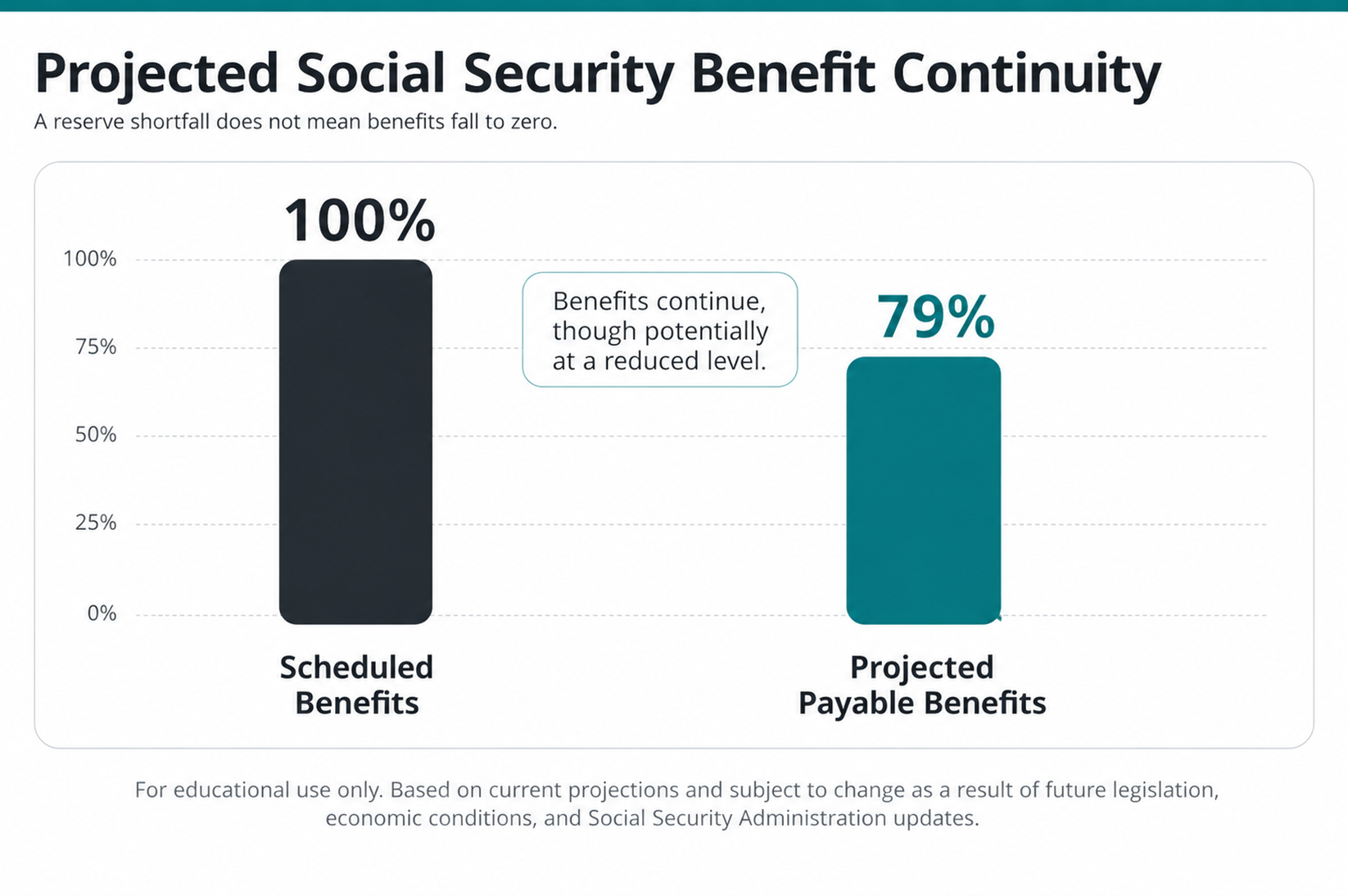
*Illustrative Example: This illustration is hypothetical and for informational purposes only. It is based on current assumptions and is not a guarantee of future results. Actual outcomes will vary.
What Happens If the Social Security Trust Fund Runs Out?
When people hear that Social Security is “running out,” it often creates the impression that the system is on the verge of collapse. In reality, the Trust Fund is only one part of how Social Security is financed. If it is depleted, the system would still rely on incoming payroll taxes to fund benefits.
Historically, lawmakers have addressed funding challenges well before reaching a breaking point. Social Security has evolved over time, and adjustments have been made to maintain its long-term viability. This context is important because it reframes the conversation from one of collapse to one of adaptation.
What Changes Could Be Made to Fix Social Security?
Looking back at history provides a useful perspective. In 1983, policymakers implemented a series of changes to strengthen Social Security, including gradually increasing the full retirement age and introducing taxation on benefits. These adjustments significantly extended the life of the program.
It is reasonable to expect that future changes will follow a similar pattern. Rather than sudden or drastic shifts, adjustments are typically phased in over time. These could include modifying the retirement age, adjusting benefits for higher earners, or increasing the payroll tax cap. The key takeaway is that change is likely but is generally manageable and designed to give individuals time to adjust their plans accordingly.
How Much Could Social Security Benefits Be Reduced in the Future?
Based on current projections, if no policy changes are made, Social Security benefits could be reduced to approximately 75 to 80 percent of scheduled levels. While that reduction is meaningful, it does not represent a complete loss of income.
From a planning perspective, this type of scenario can be planned for. When you begin to model different outcomes, including reduced benefits, you often find that a well-structured retirement plan remains viable. It may require adjustments, but it does not necessarily undermine the entire strategy.
How Do You Plan for Social Security Uncertainty in Retirement?
Planning for uncertainty begins with acknowledging that multiple outcomes are possible. Rather than relying on a single assumption about future benefits, a more effective approach is to evaluate different scenarios and understand how each one impacts your financial plan.
By modeling scenarios such as full benefits, partial reductions, or delayed retirement, you create a framework that is flexible and resilient. This approach allows you to move away from reacting to headlines and instead focus on building a plan that can adapt over time. 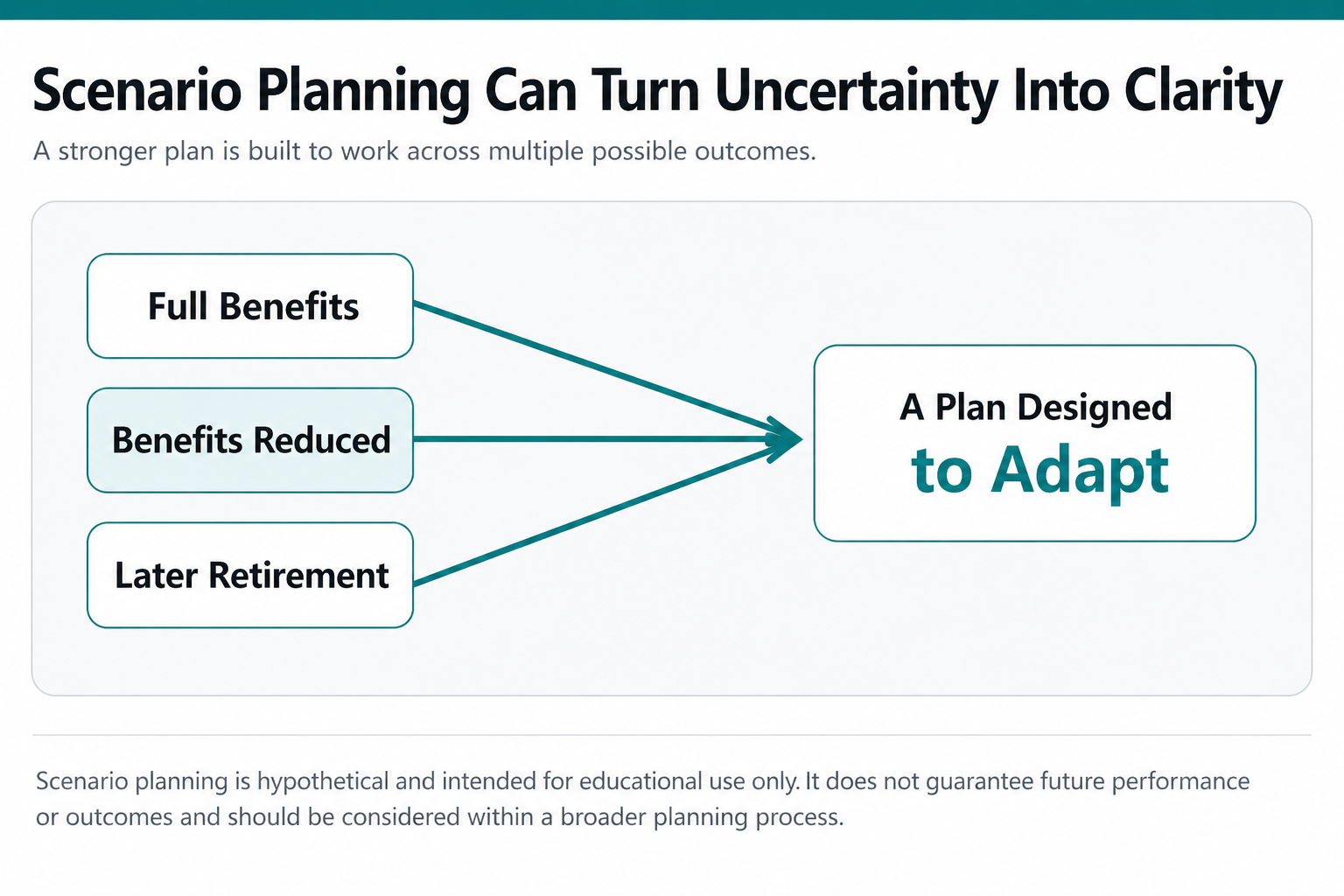
*Illustrative Example: This illustration is hypothetical and for informational purposes only. It is based on current assumptions and is not a guarantee of future results. Actual outcomes will vary.
How Much Should You Rely on Social Security for Retirement Income?
A common mistake in retirement planning is placing too much reliance on Social Security as a primary income source. While it is an important component, it was never designed to fully replace an individual’s pre-retirement income.
When a plan depends too heavily on a single income source, it becomes more vulnerable to changes. A more effective strategy is to treat Social Security as one part of a broader income framework. This reduces dependency and creates greater stability over time.
What Are the Best Ways to Diversify Income in Retirement?
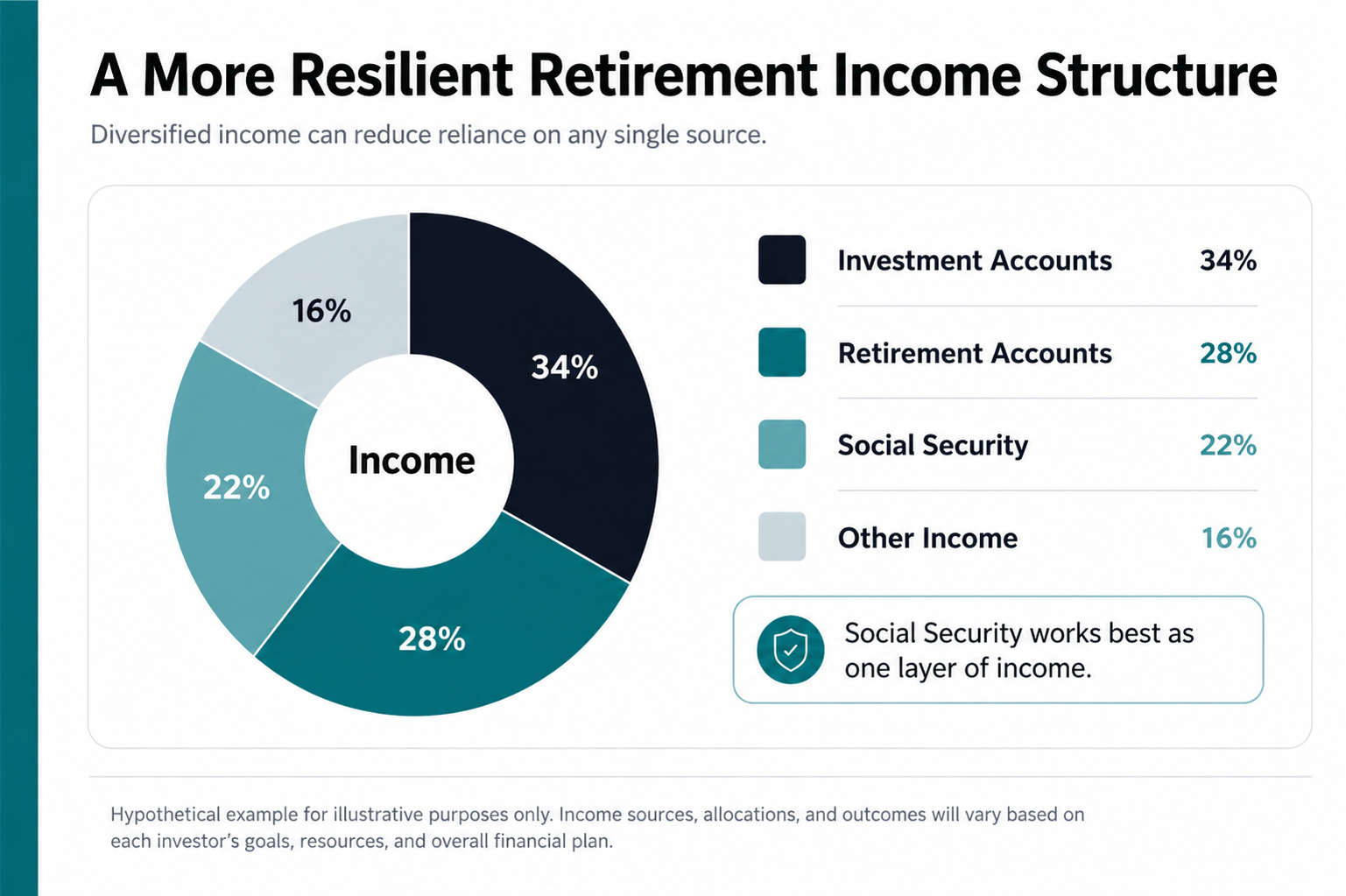
Diversification plays a critical role not only in investments but also in retirement income. A well-rounded plan typically includes multiple sources of income, such as investment portfolios, retirement accounts, and, in some cases, additional income streams.
By structuring income in this way, you reduce the impact that any single change may have on your overall financial position. Social Security then becomes a complementary source of income rather than the foundation of the plan.
*Illustrative Example: This illustration is hypothetical and for informational purposes only. It is based on current assumptions and is not a guarantee of future results. Actual outcomes will vary.
What Can You Actually Control When Planning for Retirement?
While there are many aspects of the financial landscape that remain outside of your control, there are also several factors that have a direct and meaningful impact on your long-term success. These include how much you save, when you choose to retire, how your income is structured, and how efficiently your plan is managed from a tax perspective.
Decisions around when to claim Social Security and how to coordinate it with other income sources also play a significant role. When these elements are managed thoughtfully, they can help improve flexibility and support more consistent outcomes over time.
Strong retirement plans often emphasize focusing on controllable decisions, particularly in areas where markets, policy, and timing are uncertain. Rather than trying to predict external factors, a more effective approach is to concentrate on the decisions that can be adjusted and refined over time. Focusing on these controllable factors allows you to take a more proactive approach to retirement planning, rather than reacting to external events that cannot be predicted or influenced. 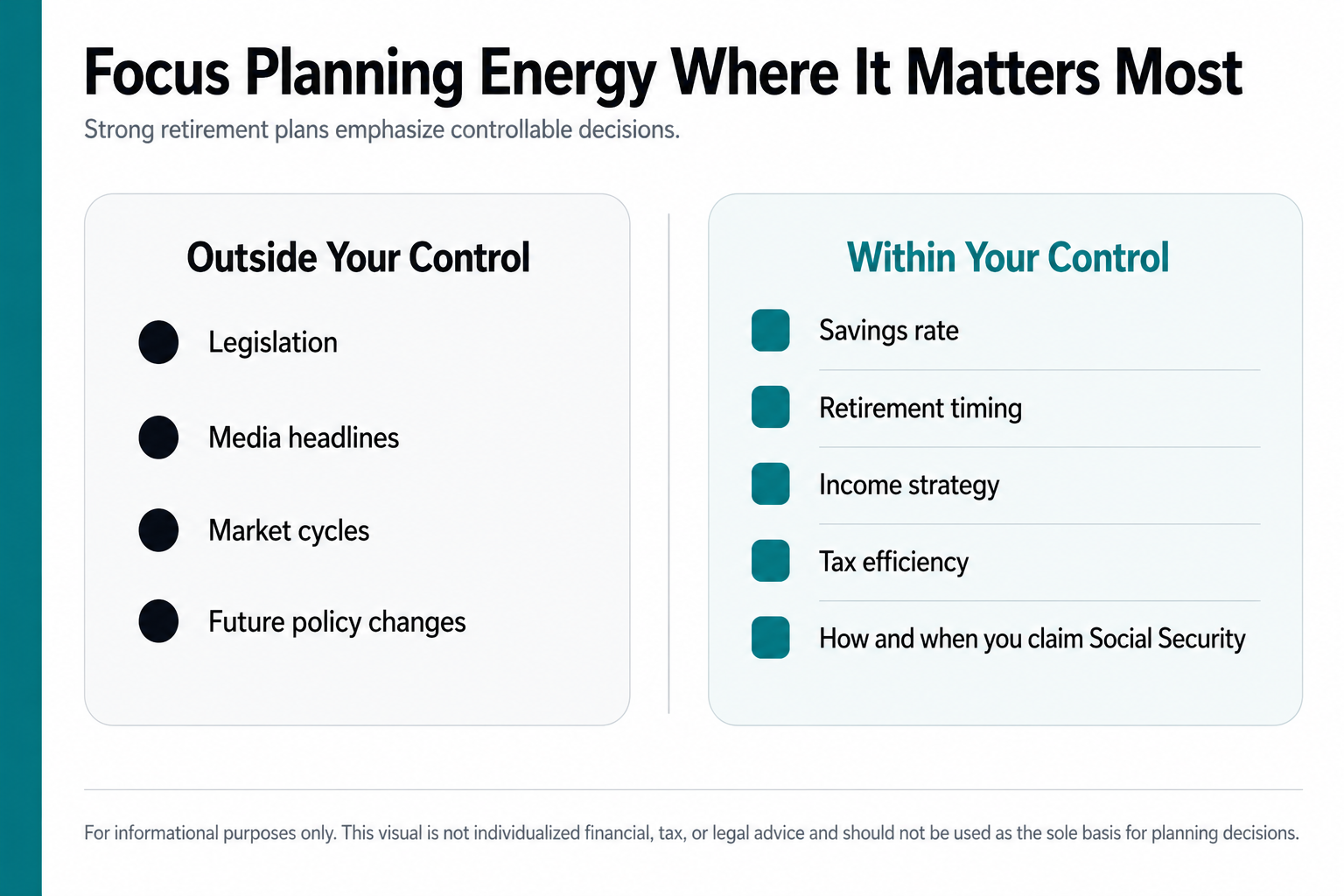
*Illustrative Example: This illustration is hypothetical and for informational purposes only. It is based on current assumptions and is not a guarantee of future results. Actual outcomes will vary.
How Should Social Security Fit into a Retirement Plan?
A more productive way to think about Social Security is not whether it will exist, but how it fits into your overall strategy. When viewed in this context, Social Security becomes one component of a larger plan rather than the primary source of support.
This perspective shifts the focus toward building a plan that is strong on its own, with Social Security enhancing the outcome rather than defining it. When structured this way, potential changes to the system become less disruptive and easier to manage. 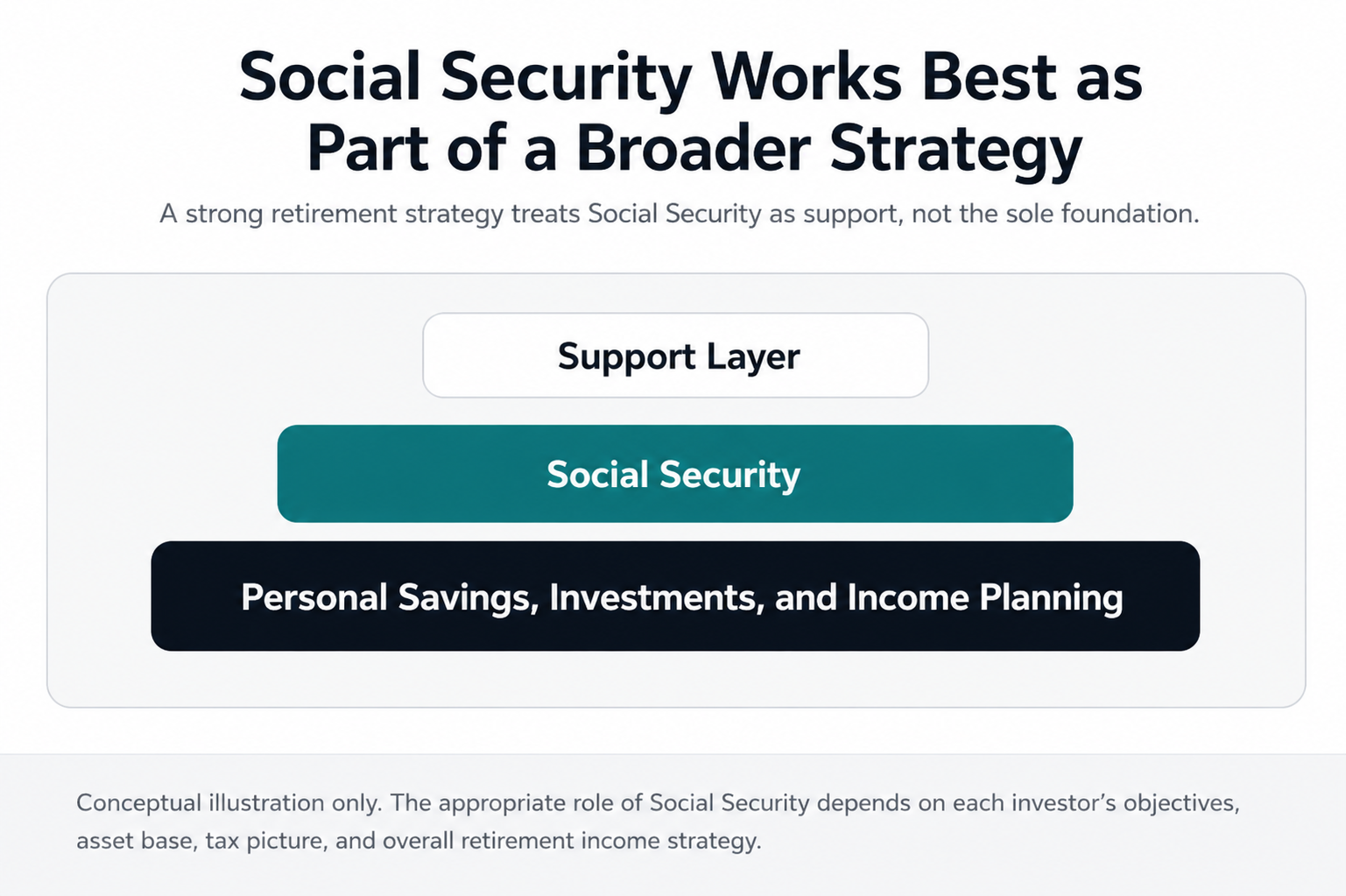
*Illustrative Example: This illustration is hypothetical and for informational purposes only. It is based on current assumptions and is not a guarantee of future results. Actual outcomes will vary.
How Do You Build a Retirement Plan That Doesn’t Depend on Social Security?
Building a plan that does not rely heavily on Social Security begins with understanding your income needs and aligning them with your available resources. This includes evaluating your savings, investment strategy, tax approach, and withdrawal plan.
A well-designed retirement plan incorporates flexibility and accounts for a range of possible outcomes. It is tested against different scenarios and adjusted over time as circumstances change. This type of structure allows the plan to remain effective regardless of shifts in policy or economic conditions.
How Can You Feel Confident About Retirement Despite Economic Uncertainty?
Confidence in retirement does not come from eliminating uncertainty. It comes from having a plan that is designed to handle it. While headlines may continue to create concern around Social Security and other financial issues, the underlying principles of effective planning remain consistent.
When you have clarity around your financial position, a diversified income strategy, and a plan that has been tested across multiple scenarios, uncertainty becomes more manageable. Instead of reacting to change, you are prepared for it.
Final Thoughts
If you are looking to build a retirement plan that accounts for potential Social Security changes while strengthening your overall financial position, it may be helpful to take a more structured approach. At GDS Wealth Management, we work with individuals to evaluate their current strategy, identify potential gaps, and develop a plan designed to provide long-term confidence.
GDS Wealth Management is a registered investment adviser. The author is an Investment Adviser Representative of GDS. Registration does not imply a certain level of skill or training. This content is for informational purposes only and is not personalized investment, tax, or legal advice. Any strategies discussed may not be suitable for all individuals and are not guaranteed to produce results. All investments involve risk, including the possible loss of principal, and past performance does not guarantee future results. Examples discussed are hypothetical and for illustrative purposes only and do not represent the experience of any specific client. Any projections or forward-looking statements, including estimates regarding Social Security benefits or future policy outcomes, are based on current assumptions and are not guarantees of future results; actual results will vary materially based on individual circumstances, legislative changes, and other factors. There is no assurance that any planning strategy will achieve its intended results or that Social Security benefits will remain unchanged. GDS does not provide tax or legal advice; please consult your tax and legal professionals regarding your specific situation. Advisory services are provided pursuant to a written agreement. For additional information about GDS, including its services and fees, please review its Form ADV available at adviserinfo.sec.gov.
