

Stock compensation can change the trajectory of a family’s financial life. For executives, physicians in leadership, technology professionals, and business leaders, RSUs, ISOs, and stock options often represent the wealth that can make early retirement, a second home, a legacy gift, or greater family security possible. It is not unusual for a compensation package to feel like the payoff for years of discipline, long hours, and trust placed in you by an organization. That is why stock compensation feels different from a paycheck. It carries a story. But the very thing that makes it meaningful can also make it dangerous. Company stock is not just another holding on a statement. It is often connected to identity, loyalty, and belief in the work you helped build. Those are honorable things. They are just not a substitute for a retirement plan. When too much of your income, your future opportunity, and your net worth are tied to the same company, you have not simply accepted investment risk. You have stacked your financial life on one outcome.
I recently recorded a Retirement Blueprint episode on this topic, where I explored how RSUs, ISOs, and stock options can be powerful tools for building wealth, but also how they can quietly create risk when too much of your financial future depends on one company. In this article, I want to expand on that discussion and take a closer look at why stock compensation feels so personal, how taxes and emotion can influence decisions, and how to think about company stock in a way that protects the retirement you have worked hard to build.
Listen on


View the full transcript of this episode here.
Why Stock Compensation Creates Hidden Concentration Risk
Concentration risk rarely feels dangerous while things are going well. The stock is rising. The company is growing. The leadership team is optimistic. Your vesting schedule looks strong, and the future seems to confirm the decisions you have already made. During seasons like that, diversification can feel unnecessary, or even ungrateful. Your balance sheet may have grown faster than your plan. But the fundamentals have not changed: retirement still requires reliable income, liquidity, tax coordination, and protection against a single point of failure. That means even a great company can become too large a piece of your financial future. Your paycheck already depends on your employer. Your bonuses, benefits, career trajectory, and future unvested grants often do as well. Adding a concentrated stock position on top of that can turn a benefit into fragility.
This matters even more as you approach retirement. In your 40s or early 50s, you may have years of earnings ahead of you to recover from volatility. In the years immediately before retirement, the margin for error changes. A sharp decline in company stock can happen at the same time bonuses are reduced, jobs are reorganized, or the broader market is under stress. That is not merely a theoretical risk. That is the kind of risk that changes retirement dates, spending decisions, and family conversations.
RSUs, ISOs, and Stock Options Are Not the Same
Restricted stock units, incentive stock options, and nonqualified stock options each have different tax rules, and those rules matter. RSUs are generally taxed when shares vest or are delivered, depending on the plan structure. Nonqualified, or nonstatutory, stock options often create ordinary income at exercise based on the spread between the stock’s fair market value and the exercise price. ISOs may receive favorable regular tax treatment, but exercising ISOs can create alternative minimum tax exposure, and favorable long-term capital gains treatment generally depends on meeting specific holding-period requirements. Tax treatment varies based on individual circumstances and applicable plan provisions. Readers should consult their tax advisor regarding the tax consequences of any stock compensation strategy.
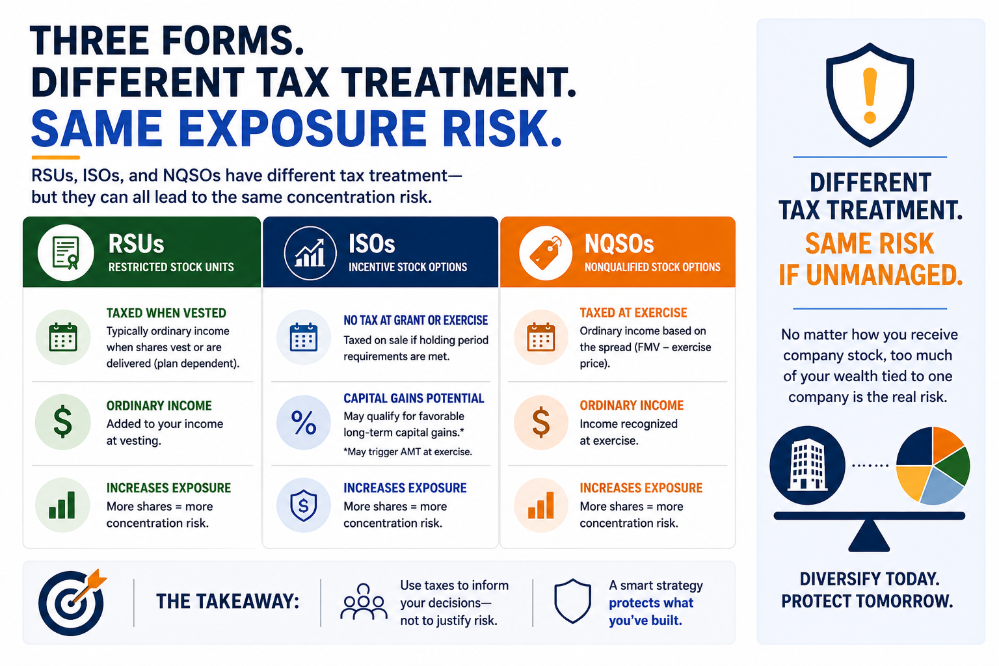 Tax treatment for RSUs, ISOs, and stock options differs and depends on individual circumstances, plan design, holding periods, and applicable tax law. This illustration is provided for educational purposes only and does not constitute tax or investment advice. Consult your tax advisor regarding your specific situation.
The Emotional Trap: “Selling Means I’m Missing Out”
The most common reason people hold too much company stock is not analysis. It is emotion. Selling can feel like you are giving up future upside, or worse, like you are no longer loyal to the company that helped create your wealth. That is understandable. If you spent years helping build something, ownership feels personal. But loyalty is not a financial strategy. A better question is this: if someone handed you the same amount in cash today, would you invest all of it into this one stock? If the answer is no, then continuing to hold is not passive. It is an active decision. Not selling is still a choice.
 Illustrative example only. Actual results will vary. Concentrated stock positions involve risk, including the possible loss of principal.
This is where a steady process helps. The decision does not have to be an all-or-nothing choice between selling everything and holding forever. Most families are better served by defining the role that company stock should play. Is it a core holding? A limited growth position? A temporary windfall meant to be diversified into a retirement income plan? Once that role is named, the decision becomes calmer and more disciplined.
Taxes Matter, But Risk Matters More
Tax planning around stock compensation can be complex, especially for high earners who may already have significant income from salary, bonuses, deferred compensation, or business interests. A poorly timed exercise or sale can create unnecessary tax drag. A thoughtful plan may coordinate vesting schedules, option expiration dates, capital gains exposure, charitable giving, and retirement cash flow needs. That kind of coordination matters.
Still, avoiding taxes should never become the reason you keep a dangerous amount of wealth in one stock. Taxes are a cost. Concentration is a threat. Those are not the same thing. A tax bill can be planned for, funded, and integrated into the broader strategy. A major decline in concentrated stock can permanently reduce the security you were counting on. I have seen people wait for a better tax year, a better stock price, more clarity from leadership, or one more vesting cycle. Waiting feels harmless because no decision is being made. But exposure is still growing in the background. In some cases, by the time the risk becomes obvious, the easiest planning opportunities have already passed.
When Holding Company Stock Can Make Sense
There are times when holding company stock is reasonable. You may have a strong conviction about the business, a long-time horizon, low exposure relative to your total net worth, or tax reasons to sell gradually rather than immediately. A measured position can be appropriate when it is intentional, sized properly, and monitored within the broader financial plan.
The key word is intentional. A concentrated position should have boundaries. It should be reviewed against your income needs, estate goals, charitable objectives, tax picture, and risk capacity. For some families, that may mean setting a target percentage of net worth. For others, it may mean selling shares as they vest, exercising options in stages, or using charitable strategies for highly appreciated stock. The right answer depends on the full picture, not just the stock price.
When It Becomes Dangerous
Company stock becomes dangerous when it quietly begins to define the plan. If your retirement date depends on the stock staying high, if your lifestyle depends on future vesting, or if your spouse would be left managing a large, concentrated position without context, the risk deserves attention. It is not enough to believe in the company. The question is whether your family can remain financially secure if the company disappoints.
Consider the situation of an executive whose net worth became heavily concentrated in company stock. The company had performed beautifully, and in many ways, holding had rewarded that decision. So, he waited. Then the market turned. The stock fell, bonuses were reduced, and the emotional pressure rose quickly because everything was tied to the same outcome. As the risks became more apparent, he reflected on the experience and said, “I did not realize how exposed I was until it hurt.” That is often how concentration risk reveals itself. It does not announce itself when confidence is high. It shows up when flexibility is already under pressure.
Build Wealth With Stock Compensation, Then Protect It
The goal is not to treat stock compensation as a problem. Properly managed, it can be one of the most powerful wealth-building tools available to executives and high-income professionals. The goal is to keep that wealth from becoming overly dependent on one company, one market cycle, or one decision delayed too long.  This illustration is provided for educational purposes only. Strategies designed to manage risk or preserve wealth cannot eliminate investment risk or guarantee future outcomes.
Selling company stock does not mean you have lost faith in your employer. It means you believe your family’s future deserves protection. Your career already gives you concentrated exposure. Your portfolio should provide balance, liquidity, and resilience. That is especially true as you move from accumulating wealth to preserving it, sustaining income, and preparing the next generation.
If you have RSUs, ISOs, or stock options and you are within sight of retirement, now is the time to put structure around the decisions. At GDS Wealth Management, we help families evaluate concentrated stock positions, coordinate tax-aware diversification strategies, and integrate stock compensation into a broader retirement blueprint. If your company stock has become a meaningful part of your net worth, schedule a complimentary consultation with our team. We will help you understand what changed, what did not, and what steps can protect the future you have worked hard to build.
For more retirement planning insights, connect with us on LinkedIn and subscribe to the GDS Wealth Management YouTube channel.
GDS Wealth Management is an SEC-registered investment adviser. Registration does not imply a certain level of skill or training. This material is provided for informational and educational purposes only and should not be construed as investment, tax, legal, or accounting advice. The views expressed are general in nature and may not apply to all individuals. Discussions regarding stock compensation, concentration risk, diversification, retirement planning, and tax strategies are illustrative and may not be appropriate for all investors. Tax treatment varies based on individual circumstances, plan provisions, and applicable law. Any examples or hypothetical scenarios are for educational purposes only, do not represent the experience of any specific client, and are not intended to predict or guarantee future results. All investments involve risk, including the possible loss of principal. Past performance does not guarantee future results. Please consult your tax and legal professionals regarding your specific situation.
