

There is a certain comfort that comes with holding cash. It feels stable, predictable, and immediately accessible. In a world defined by uncertainty, liquidity offers a sense of control that few other financial assets can match.
For many investors, particularly those who have spent decades building wealth, this instinct is understandable. After experiencing market volatility, economic cycles, and shifting financial priorities, the appeal of preserving capital becomes more pronounced. Cash, in that context, does not just represent safety. It represents certainty.
But what often goes unexamined is the long-term cost of that certainty. Because while cash can protect against short-term volatility, it introduces a different kind of risk over time, one that is quieter, less visible, and often far more damaging to lasting financial outcomes.
Why Does Holding Cash Feel So Safe?
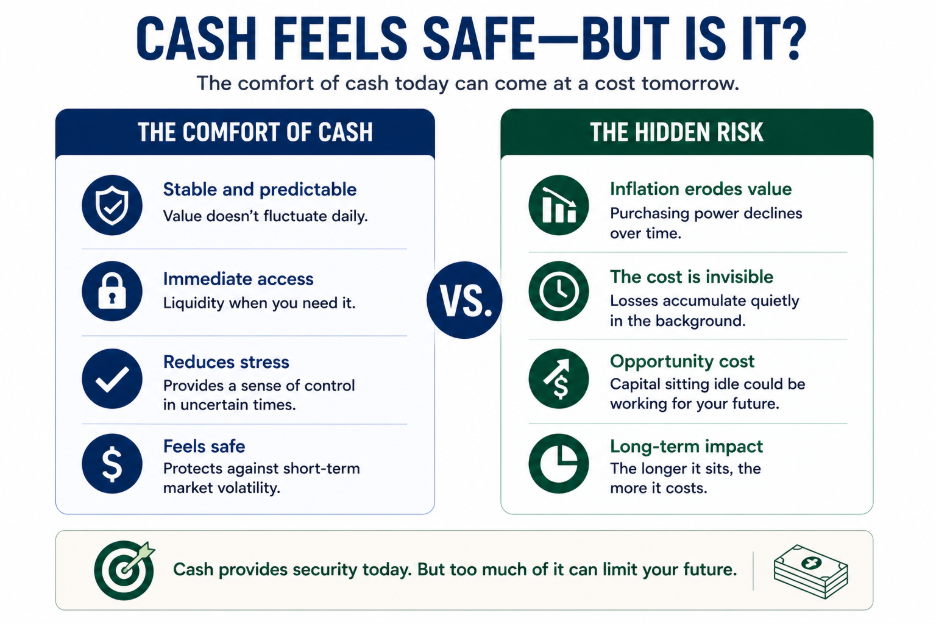
Cash provides immediate clarity. Its value does not fluctuate daily in the way that equities or fixed income securities do, and it does not require interpretation or patience. A dollar held in cash today will still be a dollar tomorrow.
 For informational and educational purposes only. Illustration is hypothetical and is not intended to predict or guarantee future results. Investing involves risk, including possible loss of principal.
That stability creates a powerful psychological advantage. Investors are not forced to react to market movements, and there is no need to question whether the timing of a decision was correct. In many ways, cash removes complexity. However, simplicity and safety are not always the same thing. What cash protects against in the short term, market volatility, it sacrifices purchasing power over time.
What Is the Hidden Risk of Holding Too Much Cash?
The primary risk of holding excess cash is not loss in nominal value, but erosion in real value. Inflation, even at moderate levels, steadily reduces what cash can actually purchase over time.
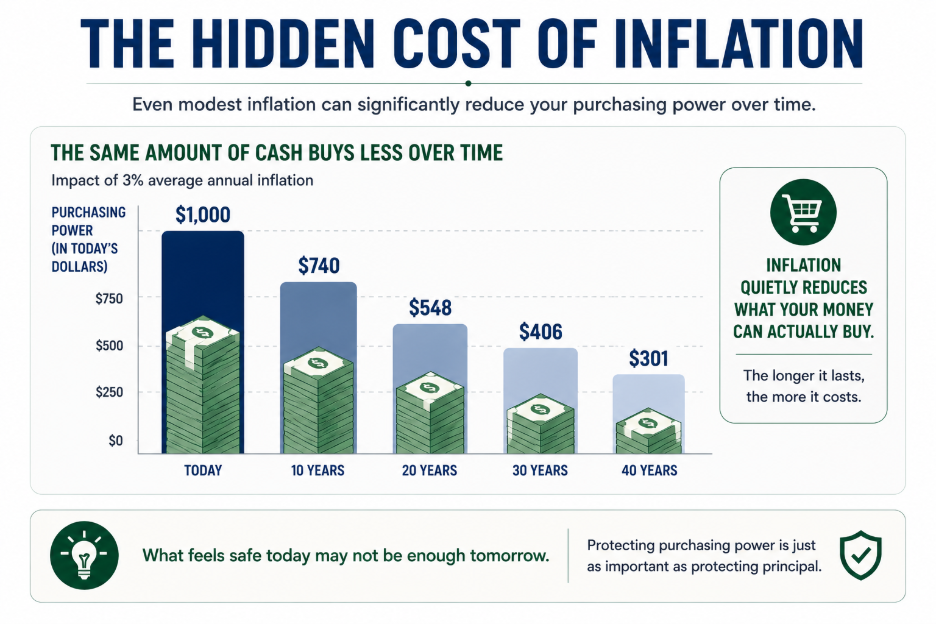
For informational and educational purposes only. Hypothetical illustration based on a 3% average annual inflation rate. Not intended to predict or guarantee future results. Investing involves risk, including possible loss of principal.
This erosion is gradual, which is why it is often overlooked. Unlike market losses, which are visible and immediate, the impact of inflation compounds quietly in the background. Over extended periods, the difference becomes significant. For high-net-worth investors, this is particularly important. Larger balances amplify the impact of even small inefficiencies. A portfolio that is overly concentrated in cash may feel conservative, but it can create a meaningful drag on future growth. In this sense, cash does not eliminate risk. It transforms it.
How Does Inflation Quietly Reduce Wealth Over Time?
Inflation does not need to be extreme to be impactful. Even modest, consistent increases in the cost of living can meaningfully reduce purchasing power over time. A portfolio that remains heavily in cash may maintain its nominal value, but its ability to support future spending declines. This becomes especially relevant in retirement, where income must sustain a lifestyle over decades rather than years. What makes this dynamic challenging is that it rarely feels urgent. There is no single moment where the loss is realized. Instead, it accumulates slowly, often unnoticed until the effects become more difficult to reverse. This is one of the reasons why cash, while appearing stable, can introduce lasting instability.
When Does Liquidity Become a Liability?
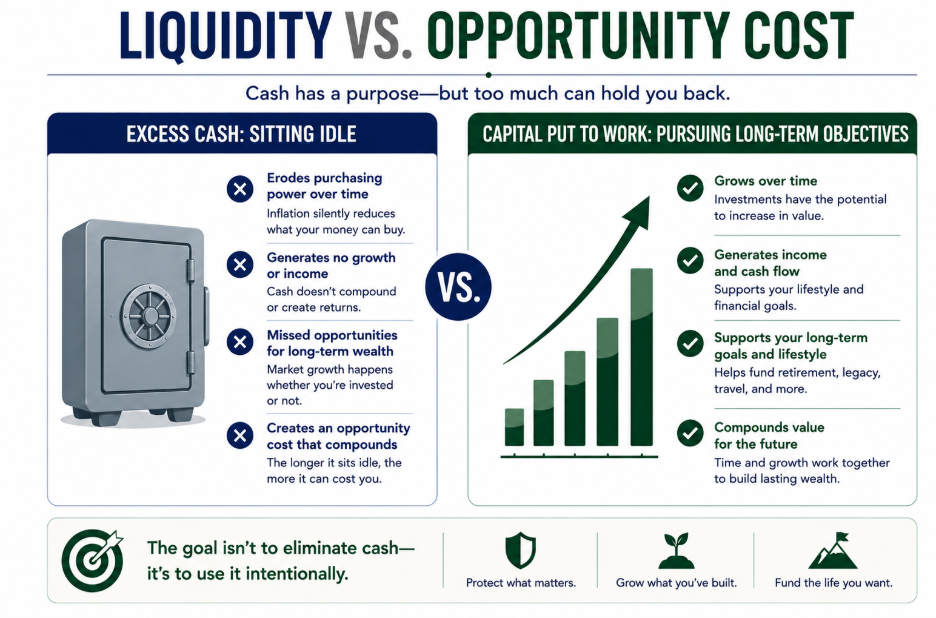
Liquidity is essential. Having access to capital for emergencies, opportunities, and near-term needs is a critical component of any well-structured financial plan. The issue arises when liquidity exceeds its intended purpose. Beyond a certain point, additional cash no longer increases flexibility. Instead, it begins to reduce efficiency.
 For informational and educational purposes only. Illustration is hypothetical and is not intended to predict or guarantee future results. Investing involves risk, including possible loss of principal.
Capital that could be working toward broader financial objectives remains idle, creating an opportunity cost that compounds over time. For high-net-worth investors, this balance becomes more nuanced. The goal is not to eliminate cash, but to define its role clearly. Without that definition, liquidity can shift from a strategic asset to an unintentional drag on performance.
What Role Should Cash Play in a Well-Structured Portfolio?
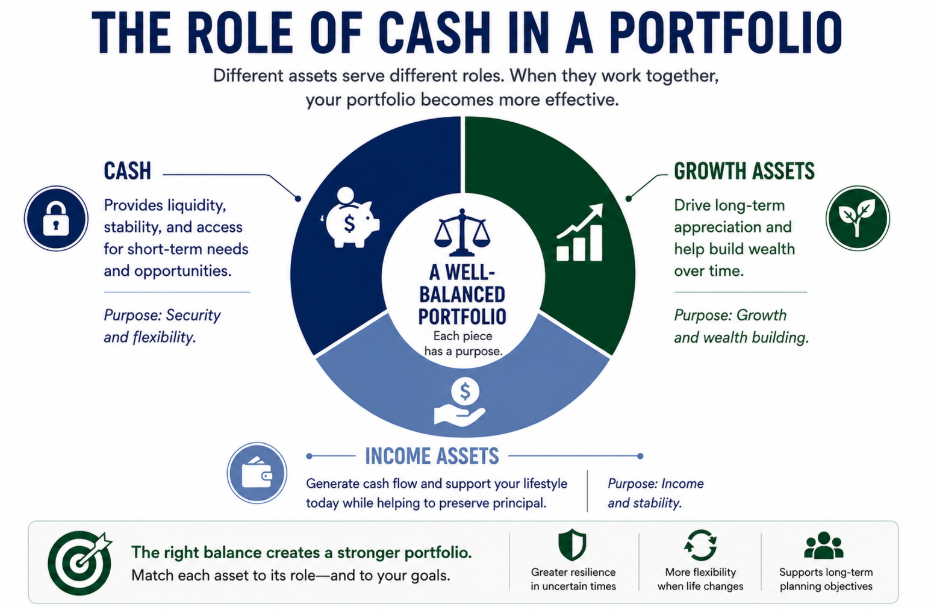
Cash is most effective when it is aligned with a specific purpose. This may include short-term spending needs, emergency reserves, or planned future expenses. Outside of those uses, capital is generally more effective when positioned in a way that supports growth and income generation over time. This does not mean taking unnecessary risk. It means aligning assets with time horizon and objective. A well-structured portfolio recognizes that different assets serve different roles.
For informational and educational purposes only. Illustration is hypothetical and is not intended to predict or guarantee future results. Investing involves risk, including possible loss of principal.
Growth assets are intended to appreciate over time. Income-producing assets support cash flow. Cash provides stability and accessibility. When those roles are clearly defined and coordinated, the portfolio becomes more efficient as a whole.
How Can Investors Balance Safety and Growth More Effectively?
The balance between safety and growth is not achieved by choosing one over the other. It is achieved through coordination. Investors who hold excessive cash are often responding to uncertainty. The solution is not to eliminate that concern, but to address it through structure rather than avoidance. Diversification, income planning, and thoughtful asset allocation can create stability without sacrificing opportunities. By aligning assets with both immediate needs and future goals, investors can maintain flexibility while still allowing their capital to work effectively. This approach does not rely on predicting markets. It relies on building a system that can function across different conditions.
Final Thought: Is Cash Really the Safe Option?
Cash plays an important role in any financial plan, but it is not without cost. While it protects against volatility in the short term, it introduces a more subtle form of risk over time, one that can erode purchasing power and limit future growth. For high-net-worth investors, the challenge is not determining whether to hold cash. It is determining how much is appropriate, and how that decision fits within the broader strategy. Because true financial stability is not created by avoiding risk entirely. It is created by understanding which risks matter and managing them intentionally.
If you would like guidance building a portfolio strategy that balances liquidity, growth, and long-term income needs in a coordinated way, the team at GDS Wealth Management can help you evaluate where you stand and identify planning opportunities related to efficiency, flexibility, and lasting financial goals.
For more information, connect with us on LinkedIn and subscribe to the GDS Wealth Management YouTube channel.
GDS Wealth Management (“GDS”) is an SEC-registered investment adviser. Registration does not imply a certain level of skill or training. This material is provided for informational and educational purposes only and should not be construed as investment, tax, legal, or accounting advice. The views expressed are general in nature and may not apply to all investors. Any examples or illustrations are hypothetical, provided for educational purposes only, and are not intended to predict or guarantee future results. Investing involves risk, including the possible loss of principal. Past performance does not guarantee future results. Please consult your professional advisers regarding your specific circumstances. For additional information regarding GDS, including our services and fees, please refer to our Form ADV available at www.adviserinfo.sec.gov.
