

There’s a belief that quietly shapes how many people approach investing: if you can just get in at the right time and get out before things go wrong, you can outperform everyone else.
It sounds logical. It feels smart. It creates a sense of control. But in practice, that mindset is often one of the most common reasons investors fall short of their long-term goals. Because successful investing is not built on precision; it is built on participation.
I recently recorded a Retirement Blueprint episode on this topic, exploring why long-term investing has historically outperformed short-term decision-making. In this article, I want to expand on those ideas and walk through what the data shows, and why behavior, not intelligence, is often the deciding factor in long-term investment outcomes.
Listen on


View the full transcript of this episode here.
Why Is Time in the Market More Important Than Timing the Market?
In most areas of life, time introduces uncertainty. The longer you wait, the more variables can change. Investing, however, operates differently. Historically, the longer an investor remains in the market, the higher the probability of achieving a positive return. While short-term movements are unpredictable, long-term trends have shown consistency over time in broad markets.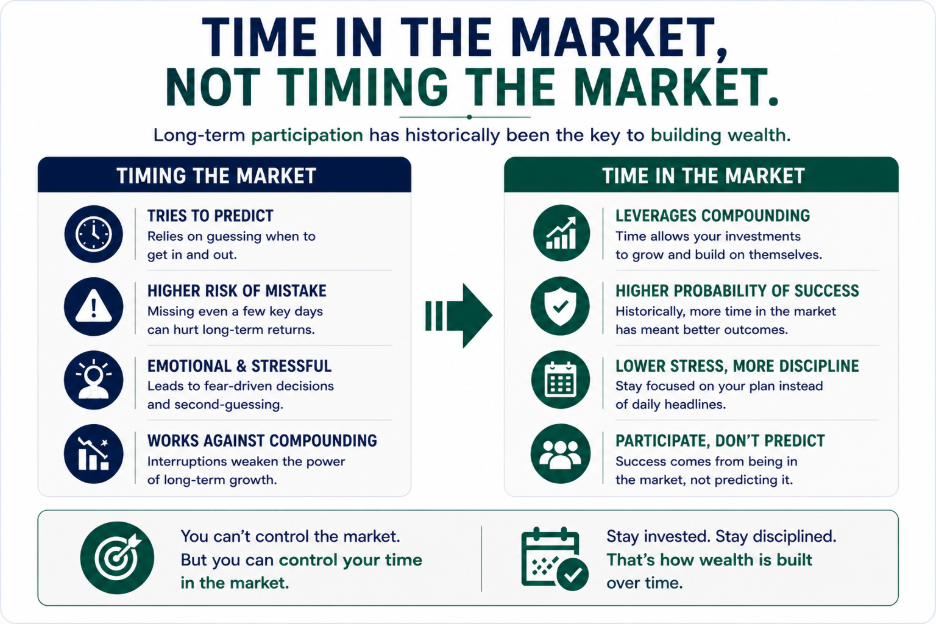 *Illustrative Example – Hypothetical. For informational purposes only. Not representative of any specific client. Assumptions are simplified and results will vary.
Despite this, many investors behave as if short-term timing is the key to success. They move in and out of the market, react to headlines, and attempt to anticipate what will happen next. In doing so, they unintentionally work against the very force that creates long-term wealth: compounding.
Why Does Market Timing Rarely Work for Investors?
Market timing is appealing because it promises an edge. If you can avoid downturns and capture gains, it seems like a more efficient path to success. However, timing the market requires getting two decisions right: when to exit and when to re-enter. Missing either one can significantly reduce long-term returns. The challenge is that the market’s strongest days often occur very close to its worst days in historical market cycles. Investors who step out during periods of uncertainty frequently miss the recovery that follows.
This creates a pattern where fear leads to selling, hesitation delays reinvestment, and opportunity is lost. Over time, these interruptions can meaningfully impact portfolio growth, not because the market failed, but because the strategy did. 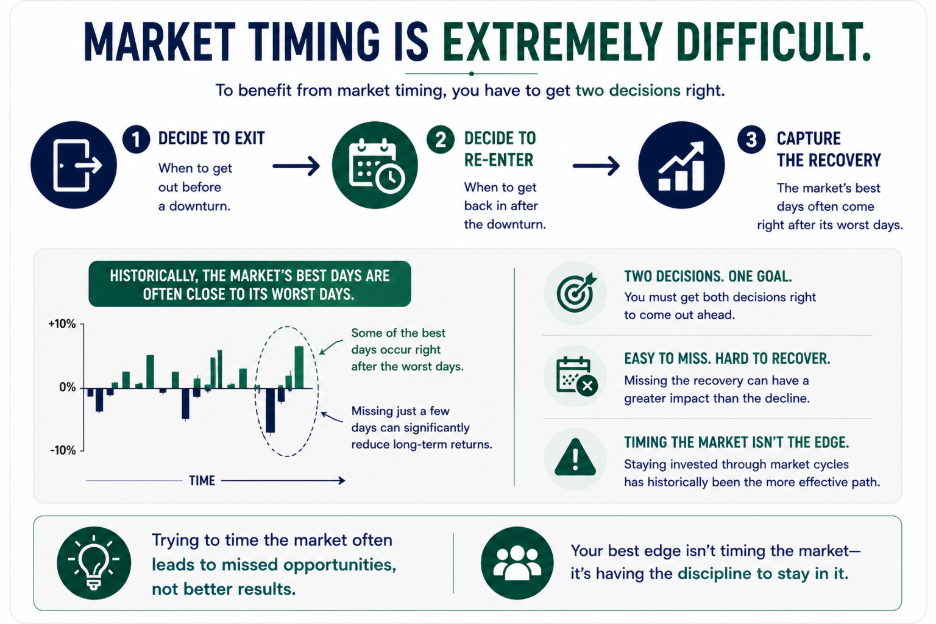 *Illustrative Example – Hypothetical. For informational purposes only. Not representative of any specific client. Results will vary.
What Happens When Investors React Emotionally to the Market?
Consider a hypothetical example of an investor who spent decades saving and investing consistently. Early success in the market-built confidence, but a major downturn created concern about further losses. In response, he moved to more conservative assets with the intention of returning once conditions improved. However, re-entering the market proved more difficult than expected. Each recovery felt uncertain, and each pullback reinforced hesitation. 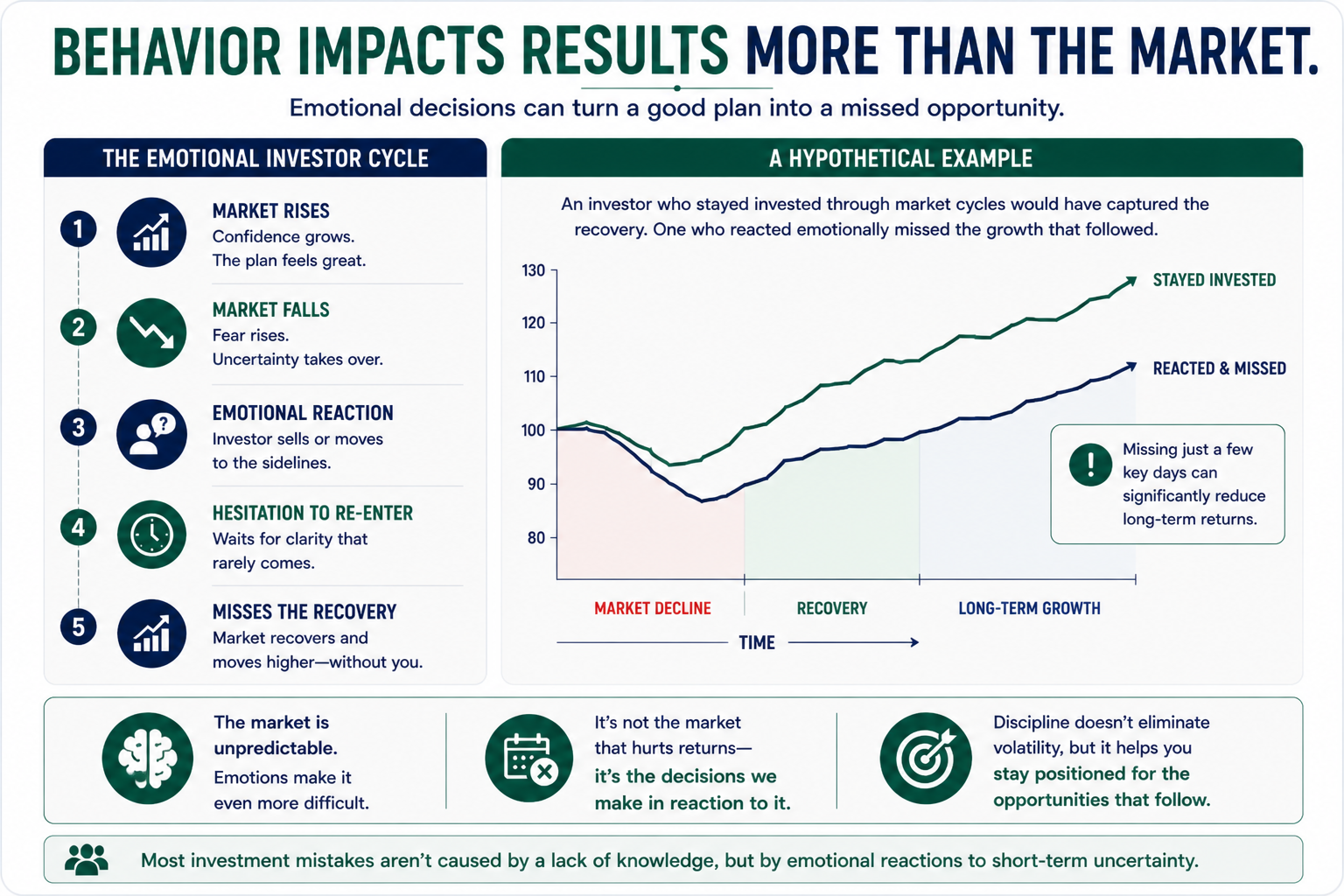 *Illustrative Example – Hypothetical. For informational purposes only. Not representative of any specific client. Results will vary.
Over time, the market recovered and continued to grow, but his portfolio did not participate in that recovery. When evaluated later, it became clear that remaining invested in a diversified portfolio would have produced a significantly better outcome based on historical market performance. This example highlights an important truth. Most investment mistakes are not caused by a lack of knowledge, but by emotional reactions to short-term uncertainty.
Is Investor Behavior a Bigger Risk Than Market Volatility?
One of the most important insights for long-term investors is that market volatility is temporary, but behavioral decisions can have lasting consequences. When investors exit the market during downturns, they often lock in losses and miss the recovery. When they re-enter after markets rise, they risk buying at higher valuations. This pattern is rarely intentional. It is the result of emotional decision-making during periods of uncertainty. Over time, these decisions can erode returns more than the market itself. This is why consistency is often a more important factor than prediction.
What Do Successful Long-Term Investors Do Differently?
Investors who achieve consistent long-term results tend to share a common approach. They remain invested, avoid reacting to short-term noise, and focus on maintaining a disciplined strategy. Rather than trying to predict market movements, they prioritize diversification, maintain a consistent allocation, and allow compounding to work over time.
This approach may not feel exciting, but it is often far more reliable. Investing success is rarely about making a perfect decision at the right moment. It is about making sound decisions consistently and giving those decisions time to produce results.
How Does Time Turn Into an Advantage in Investing?
In a fast-moving world, patience is often overlooked. In investing, however, it becomes one of the most valuable advantages an investor can have. Time allows compounding to accelerate growth, market cycles to smooth out volatility, and long-term trends to outweigh short-term fluctuations. As an investor’s time horizon increases, the importance of timing decreases. This shift allows investors to focus less on prediction and more on participation.
Is Investing Really Different from Gambling?
Investing and gambling are often compared because both involve uncertainty. However, the underlying dynamics are fundamentally different. In gambling, the longer you play, the more likely you are to lose due to the structure of the system. In investing, historically, the longer you remain invested, the more likely you are to achieve positive outcomes in diversified markets. This distinction reframes the experience. Instead of trying to outguess the market, investors can align themselves with long-term growth and economic expansion.
How Do You Build an Investment Strategy You Can Stick With?
Long-term success is less about selecting the perfect investment and more about building a strategy that can be followed consistently. That means creating a plan that accounts for market volatility, emotional responses, and long-term financial goals. A strong strategy is not one that looks perfect on paper, but one that remains intact during both strong markets and periods of uncertainty.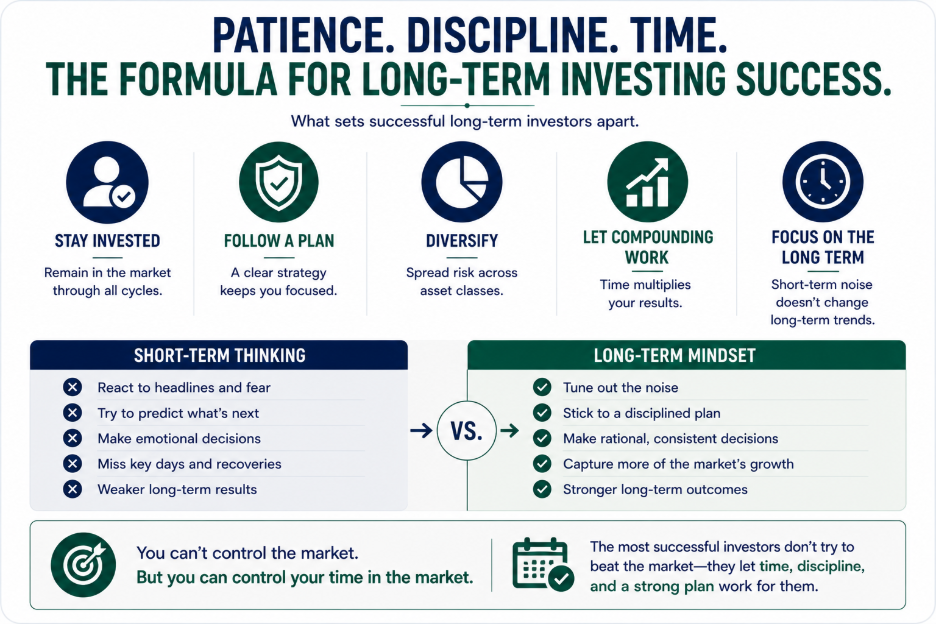 *Illustrative Example – Hypothetical. For informational purposes only. Not representative of any specific client. Results will vary.
If you would like guidance building an investment strategy designed to help you stay consistent through market cycles and align your portfolio with your long-term financial goals, the team at GDS Wealth Management can help you evaluate your current approach and create a plan built for long-term success.
GDS Wealth Management is a registered investment adviser. Registration does not imply a certain level of skill or training. This material is for informational purposes only and is not personalized investment, tax, or legal advice. The views expressed are as of the date of publication and are subject to change. Any examples are hypothetical and not representative of any specific client. References to market performance are based on historical data and are not indicative of future results. All investments involve risk, including possible loss of principal. No guarantee of results. Diversification and asset allocation do not ensure a profit or protect against loss. For additional information, including services, fees, and conflicts of interest, please review our Form ADV at adviserinfo.sec.gov.
