

For many retirees, Social Security feels straightforward: it is a benefit you’ve earned, ready to be turned on when the time comes. But that perception can be misleading.
In reality, Social Security is not just a monthly payment. It can be one of the most influential levers in your entire retirement income strategy, affecting your taxes, your investment decisions, your withdrawal plan, and even your long-term financial security.
Yet, most people make this decision in isolation. They choose a claiming age based on convenience, convention, or a simple desire to “start collecting” without considering how that choice ripples through the rest of their plan.
I recently recorded a Retirement Blueprint episode on this topic, focusing on how Social Security integrates with your broader financial picture. In this article, I want to expand on those ideas and walk through how claiming decisions can shape everything from tax efficiency to portfolio performance.
Listen on


View the full transcript of this episode here.
The question isn’t just when you should claim Social Security; it’s how that decision fits into the bigger system you’re building for retirement.
Is Social Security Really the Foundation of Your Retirement Plan?
Retirement planning is often approached as a checklist: claim Social Security, start withdrawing from accounts, and adjust your portfolio. But these aren’t independent decisions; they’re deeply interconnected. Every choice you make influences the others.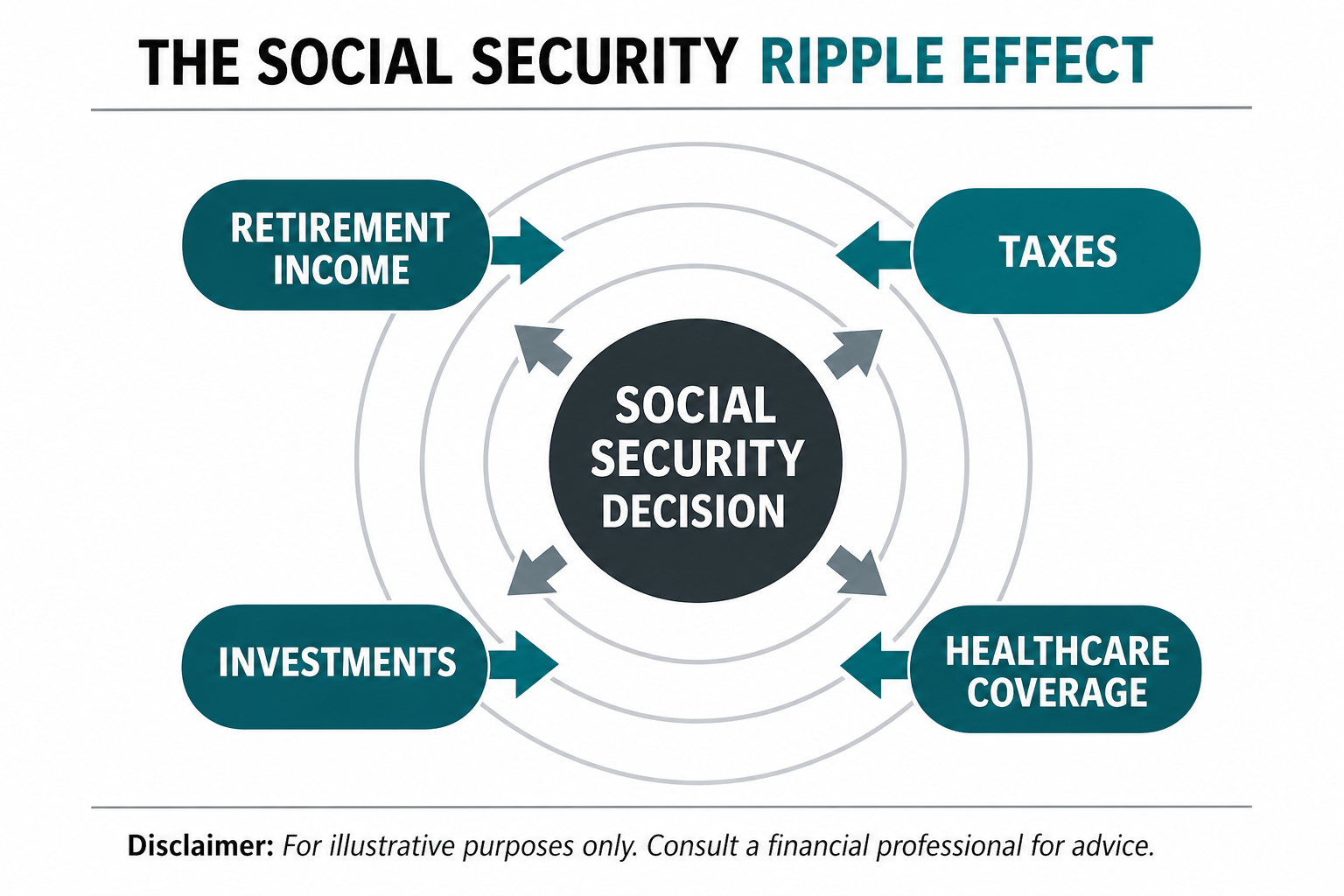
*Illustrative Example: This chart is for informational purposes only, based on hypothetical assumptions, and does not reflect actual investment results. It is not a guarantee of future performance and is intended to illustrate the potential impact of fees over time.
For example, claiming Social Security early may reduce the strain on your investment portfolio in the short term, but it also locks in a permanently lower benefit, which can reduce your income decades down the road. On the other hand, delaying benefits can significantly increase your guaranteed income, though it may require drawing more heavily from your portfolio in the early years. 
*Illustrative Example: This chart is for informational purposes only, based on hypothetical assumptions, and does not reflect actual investment results. It is not a guarantee of future performance and is intended to illustrate the potential impact of fees over time.
Neither option is inherently right or wrong. The key is understanding how each choice affects the entire system. One way to think about this is through income coordination, ensuring that your Social Security, investments, pensions, and other income sources work together as a cohesive strategy rather than operating independently. When aligned properly, they can help create stability and clarity.
What Role Should Guaranteed Income Play in Retirement?
Before choosing a claiming strategy, it’s important to step back and ask a more foundational question: what portion of your retirement income do you want guaranteed for life? Your answer to this question shapes everything else.
If you prefer a higher level of certainty, delaying Social Security may help you build a larger base of guaranteed income. If you’re more comfortable with variability and market exposure, you may choose to rely more on your investment portfolio earlier in retirement.
Once that foundation is clear, your strategy becomes far more intentional. Instead of reacting to circumstances, you’re designing a plan around your preferences, risk tolerance, and long-term goals.
How Does Timing Social Security Impact Real Outcomes?
Consider a couple approaching retirement with a common dilemma. They’ve saved consistently, built a solid portfolio, and are ready to step away from full-time work, but they’re unsure whether to claim Social Security immediately or delay for a larger benefit.
Claiming early provides immediate income and reduces reliance on investments. Delaying, however, increases future income but requires funding in the early years of retirement from other sources. This is where strategy becomes critical.
One effective approach is often referred to as a “bridge strategy.” Instead of claiming benefits right away, retirees use cash reserves or conservative investments to cover expenses during the gap years, allowing Social Security benefits to grow. The long-term impact can be meaningful, depending on individual circumstances, including the potential for higher guaranteed income later in life, greater protection against longevity risk, and increased flexibility in portfolio management. More importantly, it can provide a greater sense of confidence, as the decision is based on a structured plan rather than uncertainty.
What Is the Three-Bucket Strategy and How Does It Create Reliable Retirement Income?
One effective way to integrate Social Security into a broader plan is through a structured allocation strategy.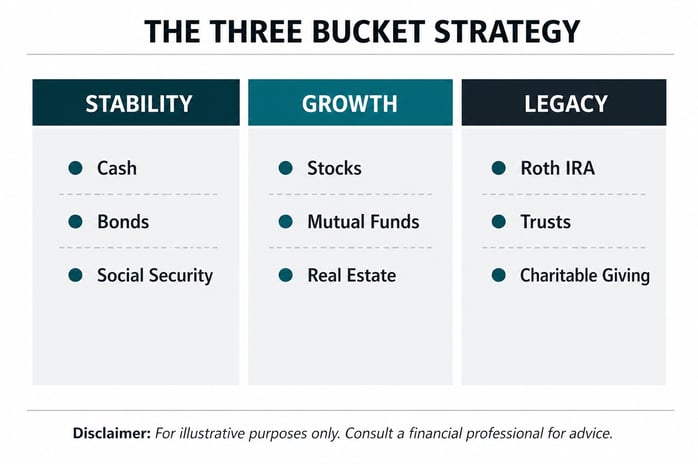 *Illustrative Example: This chart is for informational purposes only, based on hypothetical assumptions, and does not reflect actual investment results. It is not a guarantee of future performance and is intended to illustrate the potential impact of fees over time.
This is often referred to as the Three-Bucket Strategy, and it provides a framework for balancing stability, growth, and long-term flexibility.
Bucket 1: Stability and Income
This bucket is designed to cover essential expenses.
It typically includes:
- Cash and short-term reserves
- Conservative fixed-income investments
- Guaranteed income sources like Social Security
When Social Security is positioned here, it becomes the foundation of your income plan, providing consistency regardless of market conditions.
Bucket 2: Growth and Longevity
This portion of the portfolio is focused on long-term growth.
It may include:
- Equities
- Diversified funds
- Real estate or other growth-oriented assets
Because your essential expenses are supported by Bucket 1, you can invest in this bucket with greater clarity and less emotional pressure.
Bucket 3: Legacy and Flexibility
The third bucket is designed for long-term goals.
This may include:
- Roth accounts
- Trust assets
- Charitable giving strategies
It provides flexibility for future opportunities, unexpected expenses, or wealth transfer. When these buckets are aligned properly, Social Security plays a central role in stabilizing the entire system.
How Do Taxes Impact Your Social Security Benefits More Than You Realize?
One of the most overlooked aspects of Social Security planning is taxation. Your benefits don’t exist in a vacuum. The way you withdraw income from other sources, such as traditional IRAs, brokerage accounts, or Roth accounts, can directly impact how much of your Social Security becomes taxable. In some cases, up to 85% of your benefits may be included in your taxable income, depending on your overall financial picture. *Illustrative Example: This chart is for informational purposes only, based on hypothetical assumptions, and does not reflect actual investment results. It is not a guarantee of future performance and is intended to illustrate the potential impact of fees over time.
That’s why withdrawal sequencing is so important.
For example:
- Drawing from taxable accounts early in retirement may help reduce provisional income
- Delaying Social Security can create potential opportunities for Roth conversions in certain situations
- Adjusting withdrawals based on market performance can help improve tax efficiency
The key principle is simple: your tax strategy should be coordinated with your Social Security strategy, not treated as an afterthought.
How Can Social Security Create Confidence During Market Volatility?
While numbers and projections are important, there’s another benefit to coordinated planning that often gets overlooked: confidence.
When a portion of your income is guaranteed, covering essential expenses like housing, food, and healthcare, you gain a level of financial stability that isn’t tied to market performance. This can fundamentally change how you respond to volatility.
Instead of reacting emotionally to market downturns, you can remain disciplined. Instead of making short-term decisions, you can stay focused on long-term outcomes. This is often referred to as the “sleep-well factor,” and it highlights an important truth: financial planning isn’t just about maximizing returns. It’s about creating a structure that supports peace of mind.
What Is the Smartest Way to Integrate Social Security into Your Retirement Plan?
Social Security shouldn’t be viewed as a standalone decision. It’s a foundational component of a much larger system, one that includes your investments, your tax strategy, and your long-term financial goals.
When these elements are coordinated, something powerful happens:
- Your income can become more predictable
- Your tax burden can become more manageable
- Your investment strategy can become more intentional
And most importantly, your plan can become aligned with your life, not just your finances. Because true wealth isn’t measured by account balances alone. It’s measured by the freedom to spend your time the way you choose.
Ready to Build a More Coordinated Retirement Plan?
If you would like guidance creating a Social Security claiming strategy that integrates with your investments, tax planning, and long-term income needs, the team at GDS Wealth Management can help you evaluate your options and build a coordinated plan designed to support confidence and financial independence in retirement.
GDS Wealth Management is a registered investment adviser. The author is an Investment Adviser Representative of the firm. This content is for informational purposes only and is not intended as personalized investment, tax, or legal advice. Strategies discussed may not be suitable for all individuals and are not guaranteed to produce results. All investments involve risk, including the possible loss of principal. Past performance does not guarantee future results. Any examples are hypothetical and for illustrative purposes only and do not reflect the experience of any specific client. Please consult your tax and legal professionals regarding your individual situation. Advisory services are provided pursuant to a written agreement. For additional information, including services and fees, please review our Form ADV available at adviserinfo.sec.gov.
