
There are few financial products that generate as much confusion and conviction as whole life insurance. For some, it is positioned as the ultimate financial tool; a place to grow wealth, manage taxes, create income, and build a legacy, all within a single strategy. For others, it is something to avoid entirely. The reality is more nuanced. Whole life insurance is neither inherently good nor inherently bad, but it is often misunderstood and, more importantly, misapplied.
I recently recorded a Retirement Blueprint episode on this topic, diving into how financial products like insurance are often misunderstood and misapplied within a broader plan. In this article, we will take a more practical approach by examining when whole life insurance works, when it does not, and why so many people end up with a solution that does not align with their financial reality.
Listen on


View the full transcript of this episode here.
Why Does Whole Life Insurance Feel So Appealing?
At first glance, whole life insurance appears to solve multiple financial challenges at once. It offers guaranteed growth, tax advantages, lifetime coverage, and the ability to accumulate cash value over time. In an environment where markets fluctuate and uncertainty is constant, those features can feel especially attractive.
However, much of that appeal comes from how the product is presented, rather than how it functions in practice. When positioned correctly, these benefits can be meaningful. But when emphasized without context, they can create expectations that are difficult to meet. Once you move beyond the marketing and begin to understand the structure, it becomes clear that the product is more complex than it initially appears.
What Does Whole Life Insurance Actually Cost?
Whole life insurance is not a simple or low-cost product. Each premium payment is divided across several layers, including insurance costs, cash value accumulation, company reserves, administrative expenses, and commissions.
Because of this structure, the cost may be higher than many alternative strategies designed to accomplish similar goals. For many households, this creates pressure on cash flow, limiting their ability to allocate money toward savings, investments, or unexpected expenses. This does not necessarily make the product inappropriate, but it does mean that the cost must be evaluated within the context of a broader financial plan.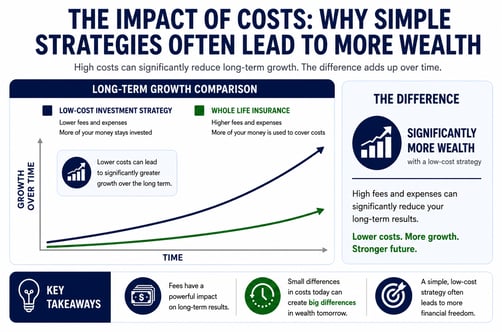
*This illustration is for informational purposes only and is based on hypothetical assumptions using generalized rates of return and cost structures. It is intended to demonstrate the potential long-term impact of fees and does not represent actual investment or insurance results. Assumptions are derived from commonly referenced market and cost data.
How Does Whole Life Insurance Perform in the Early Years?
One of the most common misconceptions about whole life insurance is how it performs in the early stages. While it is often described as a long-term asset, many individuals expect to see meaningful value develop relatively quickly.
In reality, early performance is typically slow. In some cases, the cash value may even lag behind the total premiums paid for a period of time. This creates a disconnect between expectation and experience. For individuals who anticipate flexibility or liquidity, this can be especially frustrating. Access to funds may be more limited than expected depending on policy structure and timing, and exiting the policy early may result in less value than expected. Understanding this timeline is critical before committing to the product. 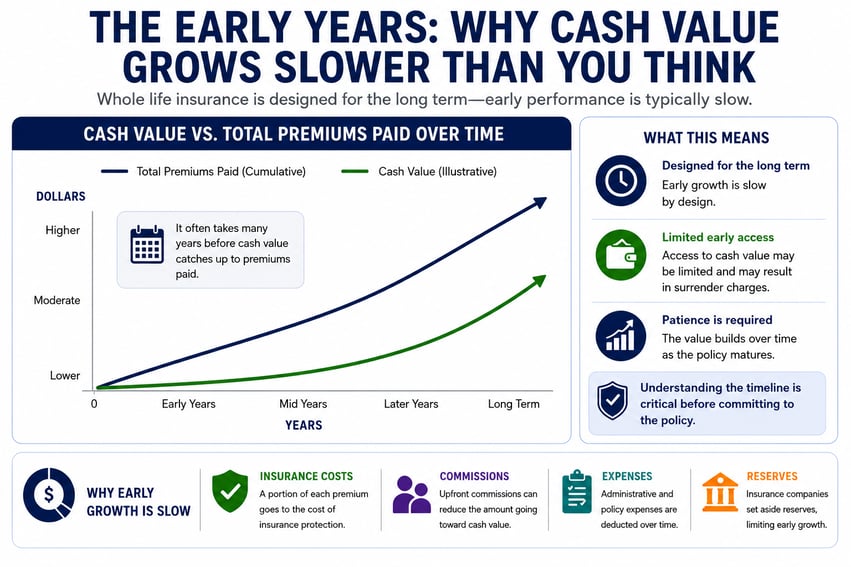
*This illustration is for informational purposes only and is based on hypothetical assumptions. It is intended to demonstrate general concepts and does not represent actual policy performance or results. Assumptions may not reflect real-world conditions, and outcomes will vary based on individual policy structure, insurer, and other factors.
Why Is Whole Life Insurance Often Introduced Too Early?
A common issue with whole life insurance is not the product itself, but the timing of when it is introduced. Rather than being positioned as one component of a comprehensive financial strategy, it is often presented as a foundational solution. This approach can create problems, particularly for individuals who have not yet established core financial priorities.
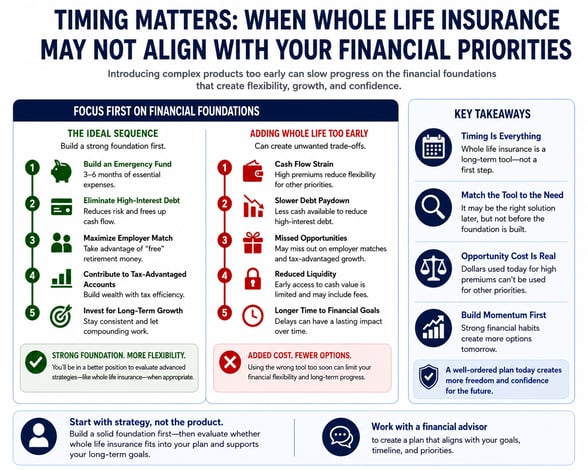
Before considering a complex insurance product, many individuals choose to focus on building an emergency fund, reducing high-interest debt, capturing employer retirement matches, and contributing to tax-advantaged accounts. When those foundational elements are overlooked, the long-term impact can be significant.
* This illustration is for informational purposes only and is based on hypothetical assumptions. It is intended to demonstrate general concepts and does not represent actual investment or insurance results. Assumptions may not reflect real-world conditions, and outcomes will vary based on individual circumstances, product structure, and market conditions.
Who Is Whole Life Insurance Actually Designed For?
Whole life insurance can serve a purpose, but it is typically designed for a more specific set of circumstances. It is often most effective for high-income individuals, advanced tax planning strategies, estate planning needs, and long-term legacy objectives. However, many families purchasing whole life insurance are not navigating those types of challenges. Instead, they are focused on building flexibility, maintaining liquidity, and growing their assets over time. When there is a mismatch between the tool and the need, the result is not just inefficient, but it often leads to frustration and missed opportunities elsewhere in the financial plan.
What Happens When a Financial Product Doesn’t Match Your Needs?
It is not uncommon to meet individuals who have contributed to a policy for years, expecting it to function as a financial safety net. However, when they attempt to access those funds during a period of need, they often discover that the value is not what they expected. This outcome is rarely due to the product failing to perform as designed. More often, it reflects a misalignment between the product and the individual’s actual financial needs. When planning is built around products instead of priorities, the results tend to fall short of expectations.
Is Whole Life Insurance a Strategy or Just a Tool?
One of the most important distinctions to make is that whole life insurance is a tool, not a strategy. A well-constructed financial plan begins with an understanding of cash flow, tax efficiency, risk management, investment growth, and long-term goals. Only after those elements are clearly defined should specific tools be introduced. When products are positioned as the strategy itself, it can lead to decisions that prioritize complexity over clarity.
Where Does Whole Life Insurance Actually Fit in a Financial Plan?
A more productive way to evaluate whole life insurance is not by asking whether it is good or bad, but by asking where it fits within a financial plan. For many individuals, it is not appropriate at the beginning of their financial journey. Early stages should focus on building flexibility, establishing strong financial habits, and creating momentum through savings and investing. As financial complexity increases over time, there may be situations where whole life insurance becomes more relevant. At that stage, it may serve a specific role within a broader strategy. Until then, it often introduces more constraints than benefits.
What Is the Most Effective Way to Make Financial Decisions?
Financial decisions should be driven by strategy, not sales. A thoughtful plan evaluates all aspects of a person’s financial life and aligns decisions with long-term objectives. This includes understanding how different tools interact with cash flow, taxes, risk, and growth over time. When those elements are aligned, the specific products used become secondary. The goal is not to find a perfect product, but to build a plan designed to align with an individual’s objectives.
The Bottom Line
Whole life insurance is not a universal solution. It is a specialized tool that can be effective in the right context, but problematic when used incorrectly. For some individuals, simpler and more flexible strategies may provide a stronger foundation, especially early in the financial planning process. Financial success is not driven by complexity. It is driven by alignment.
If you would like guidance evaluating whether whole life insurance fits into your financial plan, and how to build a strategy that prioritizes flexibility, efficiency, and long-term growth, the team at GDS Wealth Management can help you assess your current situation and identify opportunities to better align your financial decisions with your long-term goals.
GDS Wealth Management is a registered investment adviser; registration does not imply a certain level of skill or training. This content is for informational purposes only and is not personalized investment, tax, insurance, or legal advice. The views expressed are general in nature and may not apply to all individuals. Statements regarding costs, benefits, or outcomes are illustrative and may vary based on individual circumstances, policy structure, insurer performance, and timing. No representation is made that any strategy will achieve a particular result. Whole life insurance policies involve fees, expenses, and possible surrender charges, and may have limited liquidity in early years. Policy loans and withdrawals reduce cash value and death benefits and may have tax consequences. Guarantees are subject to the financial strength and claims-paying ability of the issuing insurer. All investments involve risk, including possible loss of principal. Please consult appropriate professionals regarding your specific situation. Advisory services are provided pursuant to a written agreement; for additional information, including services and fees, please review our Form ADV at adviserinfo.sec.gov.
