
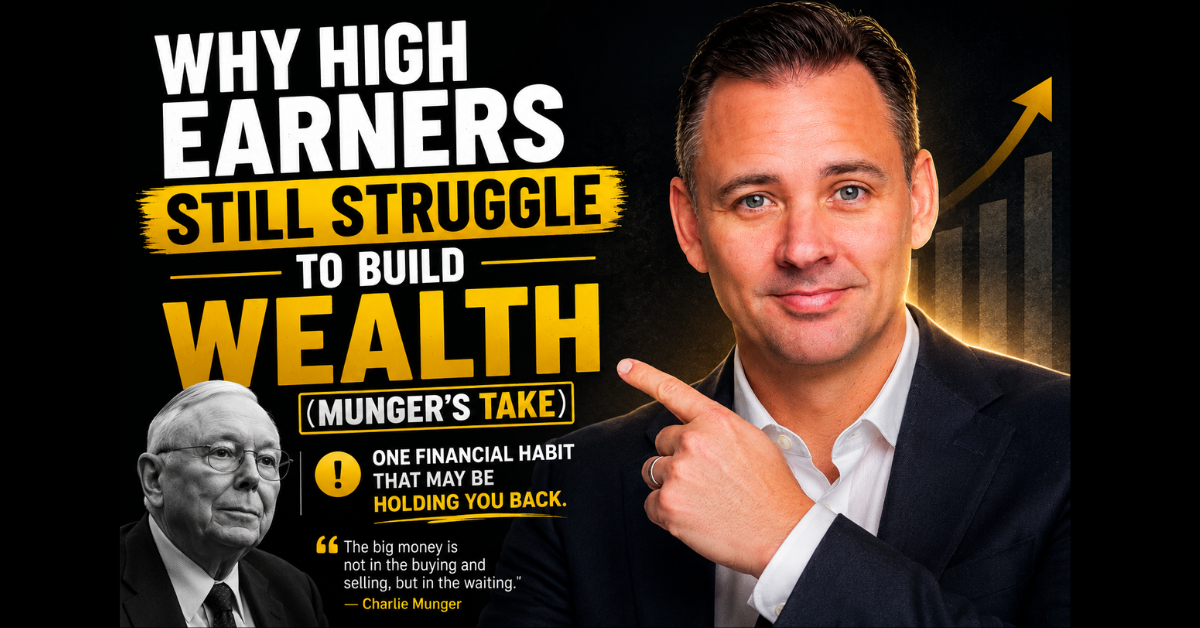
Charlie Munger had a way of saying things that were simple, direct, and difficult to ignore. One of his most important lessons was that lasting wealth is not usually lost because someone lacks intelligence. It is more often weakened by impatience, envy, and poor behavior repeated over time. That matters for high-income professionals, executives, business owners, and families with meaningful wealth. Most understand the basics: save, invest thoughtfully, avoid unnecessary risk, and think long term. The harder part is remaining disciplined when success creates more choices and more temptation.
Strong income can make almost every decision feel affordable. A larger home, a nicer car, more travel, a second property, or a new investment opportunity can each seem reasonable. But when every step forward raises the cost of daily life, wealth can become harder to preserve than it was to earn. Munger once said, “The big money is not in the buying and selling, but in the waiting.” For high earners, that is often the real test. Can you keep enough of what you earn, structure it wisely, and give it time to become lasting financial independence?
I recently recorded a Retirement Blueprint episode on this topic, where I explored why building wealth can look simple from the outside but become far more difficult once behavior, lifestyle inflation, comparison, and impatience are brought into the conversation. In this article, I want to expand on that idea and walk through why income alone does not create lasting wealth, which habits quietly weaken financial independence, and how to build a structure where your wealth has room to compound without your lifestyle consuming the freedom you are working to create.
Listen on


View the transcript of this episode here.
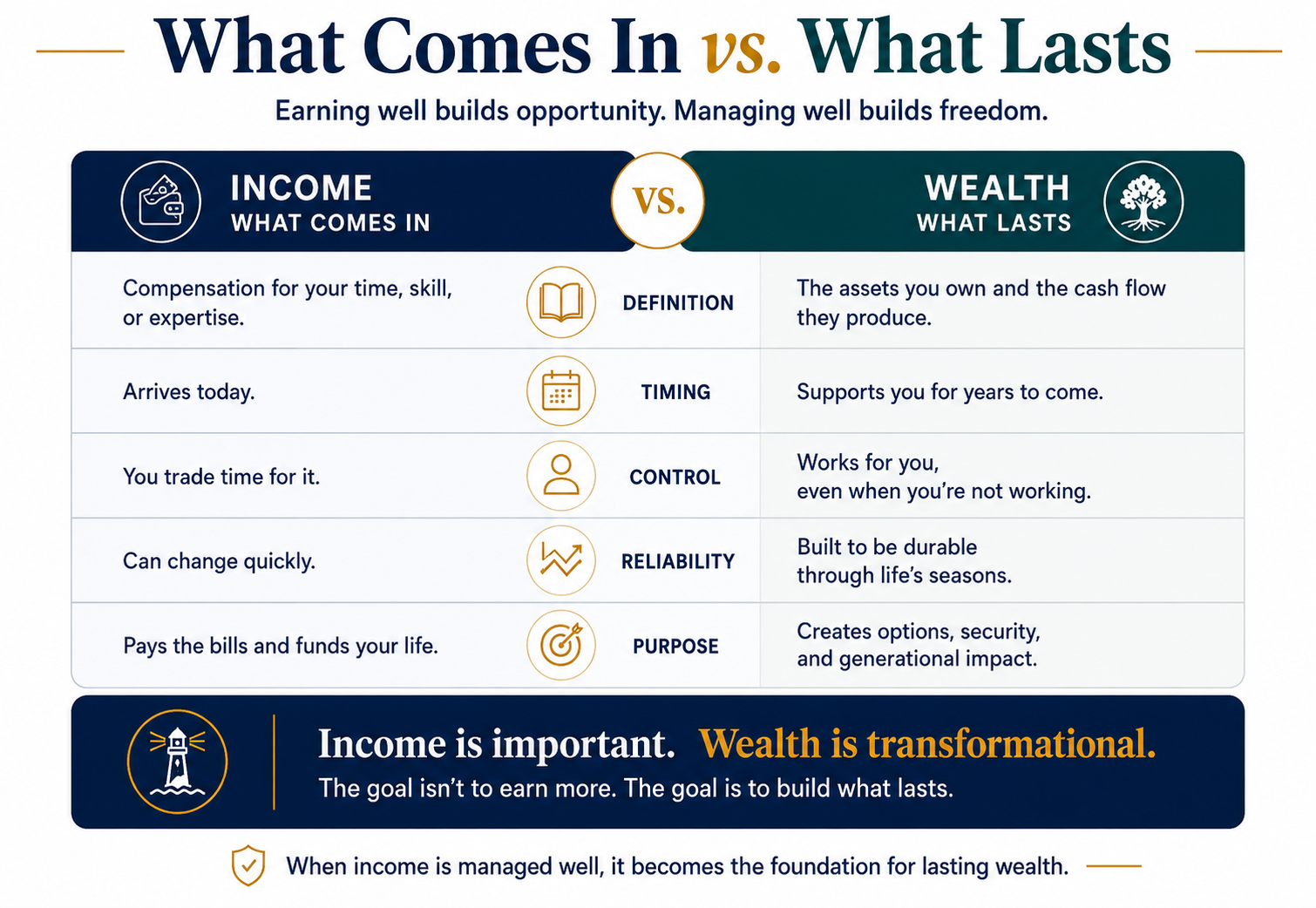
Income Is Not the Same as Wealth
One of the most common financial traps for high earners is assuming income and wealth are the same thing. They are not. Income is what comes in. Wealth is what remains, compounds, and eventually gives you options. Many successful people have financial lives that look impressive from the outside but feel more fragile underneath. They may have strong earnings, valuable assets, and a respected career, but also high fixed costs, tax complexity, debt obligations, concentrated risk, or a lifestyle that requires income to continue at a high level for longer than they would prefer.
What changed is that your financial life became more successful, but also more complex. What did not change is that lasting wealth still requires margin, patience, and disciplined decision-making.
For illustrative purposes only. Examples are hypothetical and are not intended to predict or guarantee any financial outcome.
The Quiet Cost of Always Expanding
The most dangerous financial habits are not always dramatic. They are often reasonable decisions made repeatedly. Consider the following illustrative example. A professional had a strong career, excellent income, and a thoughtful investment foundation. But when we sat down together, he said, “Glen, I feel like I’ve been running on a treadmill for 15 years.”
The issue was not one reckless purchase or one poor investment decision. Every time his income increased, his lifestyle increased with it. The larger home felt reasonable. The nicer car felt earned. The travel, conveniences, and commitments all seemed appropriate for the level of success he had achieved. But over time, those choices absorbed the margin that should have been creating freedom. His wealth was growing, but not with the force it could have. He had simply made it harder for compounding to work in his favor. 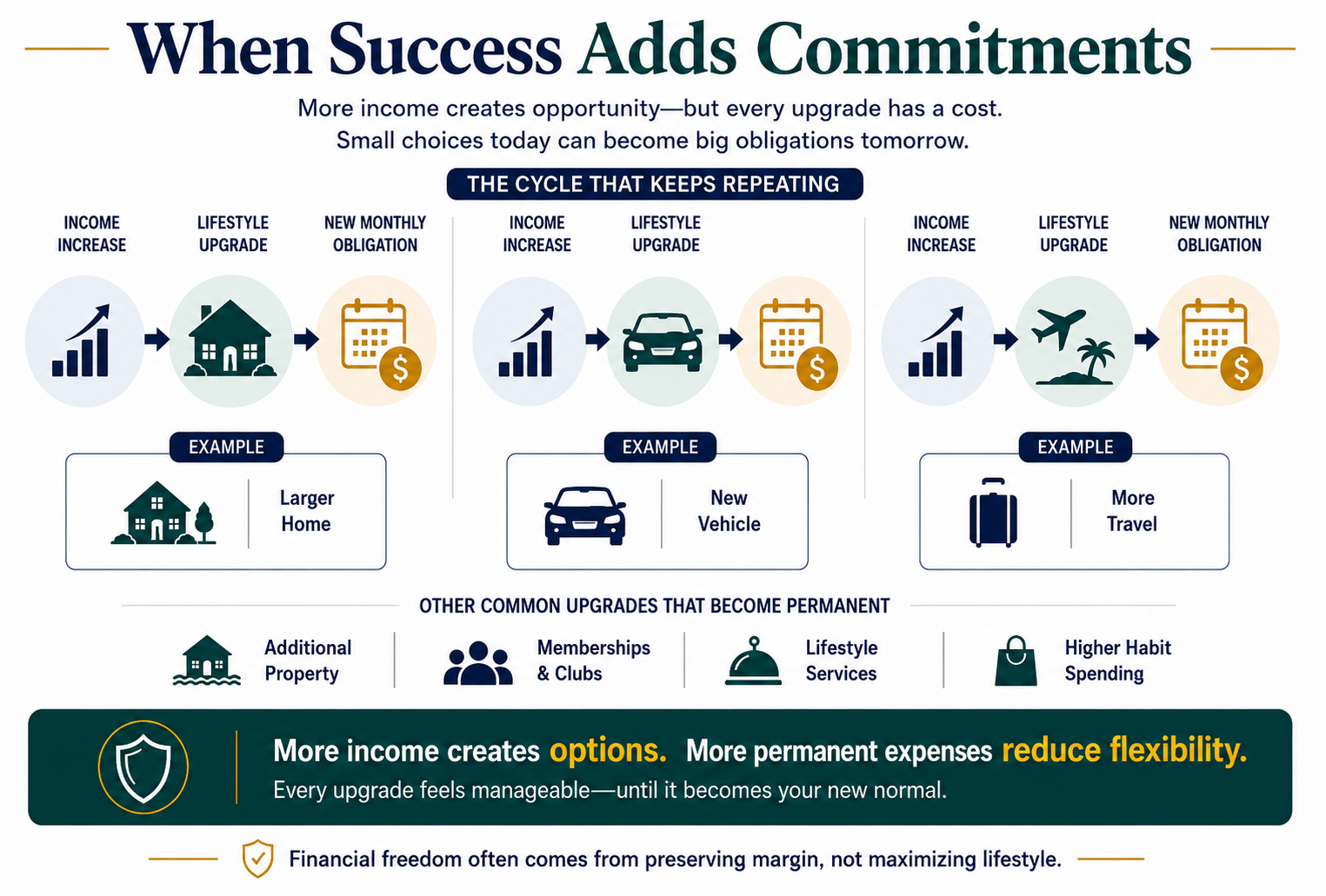
For illustrative purposes only. Examples are hypothetical and are not intended to predict or guarantee any financial outcome.
At one point, I asked him a question Charlie Munger might have appreciated: “At what point did you decide to stop needing more?” Most people have never answered that question. They are encouraged to earn more, build more, acquire more, and expand more. They are rarely encouraged to define enough. But for many successful families, needing less is one of the greatest financial advantages available. It creates flexibility, reduces pressure, and allows wealth to become a source of confidence instead of a scoreboard that always needs to be defended.
*This example is hypothetical and provided for illustrative purposes only. It does not represent the experience of any specific client.
Why Motion Can Feel Like Progress
High achievers are used to action. They built businesses, careers, teams, and reputations by making decisions and moving forward. In professional life, action often creates results. In wealth building, unnecessary action can quietly undermine progress. That is why patience is difficult. A sound investment plan can feel boring, and a long-term strategy can feel too simple for someone used to solving complex problems. So people chase returns, change strategies too often, or look for sophistication when the better decision may be to stay steady.
The goal is not passivity. Plans should be reviewed, tax opportunities evaluated, risk managed, and major life changes addressed. But not every uncomfortable season requires a new strategy. Sometimes the most productive decision is to let the plan continue working.
Comparison Can Change the Plan
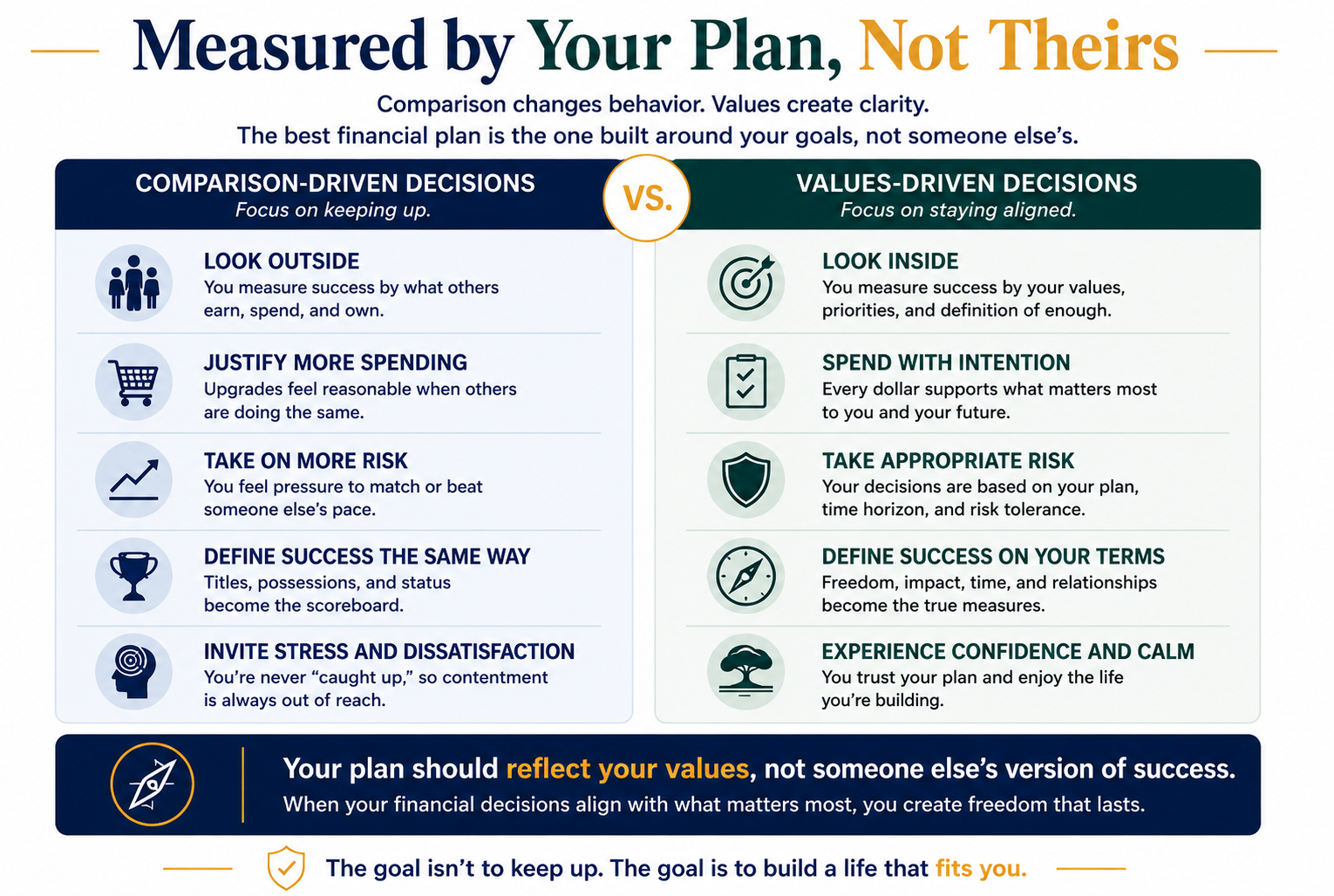
Munger often warned about envy because envy changes the way people measure success. Instead of asking, “Are we making wise decisions for our family?” envy asks, “Why does someone else appear to have more?” That question can be financially dangerous. You may see another family’s home, vacation, business exit, or public success, but not the debt, stress, illiquidity, family pressure, or risk behind it.
For high earners, comparison often looks like justification. A purchase feels reasonable because peers are doing the same thing. An investment feels necessary because others appear to be getting ahead. But another person’s spending is not a financial plan. Their timing, tax structure, family obligations, liquidity, and risk tolerance may be entirely different from yours. Lasting wealth requires the maturity to let someone else move faster without assuming you are falling behind.
 For illustrative purposes only. Examples are hypothetical and are not intended to predict or guarantee any financial outcome.
Margin Is the Luxury Many High Earners Forget to Buy
If there is one principle high earners should protect more carefully, it is margin. Margin is not just extra cash. It is breathing room. It allows a family to make thoughtful decisions instead of pressured ones. Margin gives you flexibility when markets decline, tax obligations change, expenses rise, business conditions shift, or family needs become more complex. It gives your portfolio room to compound and helps prevent one difficult season from forcing a decision you would not otherwise make.
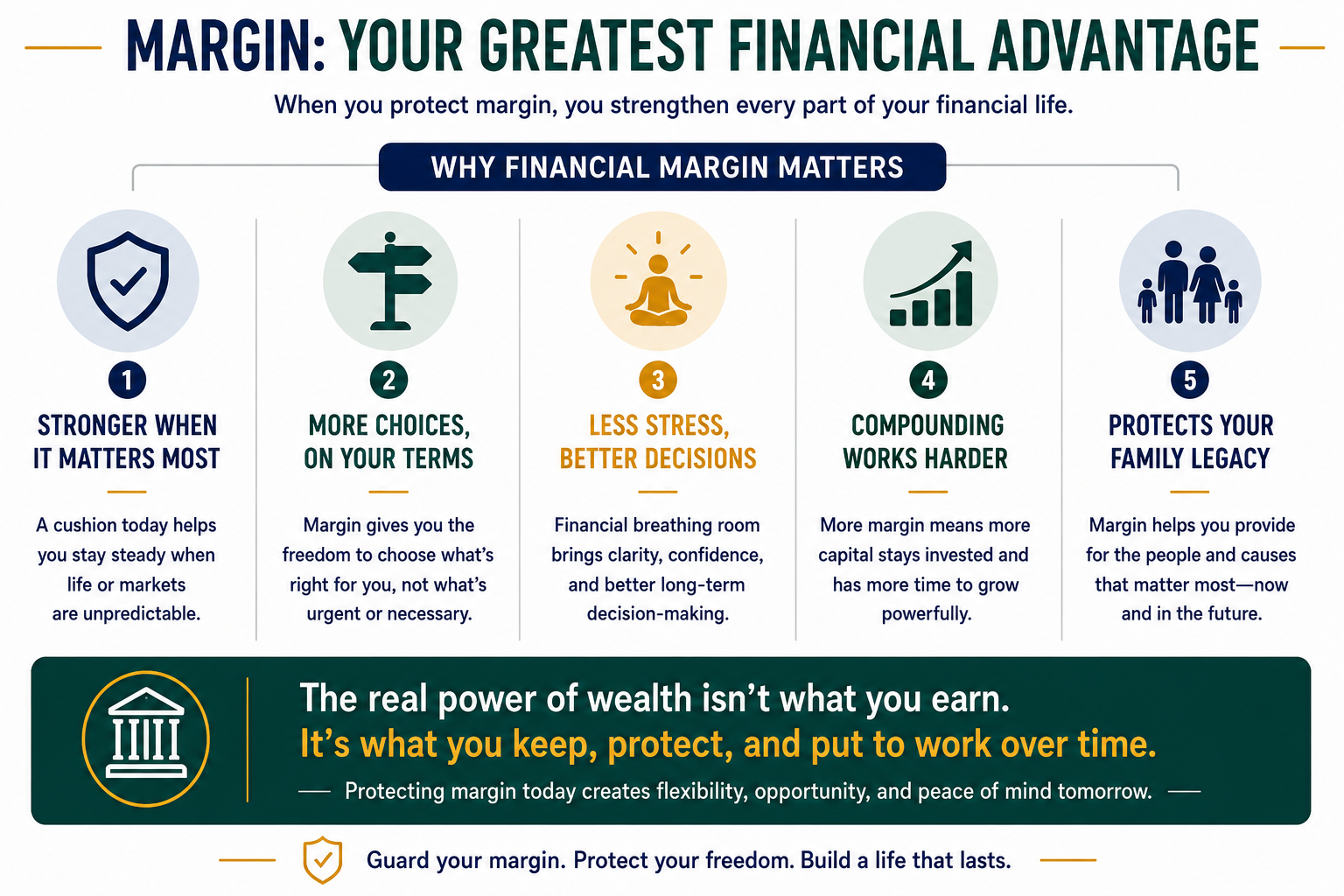
For illustrative purposes only. Examples are hypothetical and are not intended to predict or guarantee any financial outcome.
Protecting margin often means being slower to upgrade lifestyle, even when you can afford to. Every permanent expense becomes a future obligation. A high income is most powerful when it is not fully consumed. This is not about refusing to enjoy success. Wealth should support a meaningful life. But those decisions should fit inside a structure that protects long-term freedom.
Calm Is Often Better Than Clever
One of the most important conversations I have with high-income professionals is whether they are trying to build more wealth or more freedom. More wealth can be useful, but more without clarity can simply create more complexity to manage. That is why “How do I make more?” may not be the best question. A better question may be, “How do I become less dependent on more?” That question brings spending, taxes, liquidity, investment discipline, estate planning, and family priorities into the same conversation.
That is the focus of the Retirement Blueprint episode this article is based on. In the episode, I walk through why building lasting wealth for high earners requires more than strong income or good investments. We look at the assumptions that can create false confidence, including lifestyle inflation, impatience, comparison-driven decisions, portfolio overactivity, and the quiet erosion of margin.
The episode also reframes the question from “How do I build more?” to “How do I make work, wealth, and lifestyle fit together with less pressure?” For many high earners, the most sustainable path may not be a more complicated strategy, but a calmer structure: disciplined spending, tax-aware planning, sufficient liquidity, long-term investment patience, and a clearer definition of enough.
This article is only a starting point. To hear the full discussion and the planning questions worth asking before assuming income will naturally become wealth, watch the full Retirement Blueprint episode. The goal is to build a life where your wealth has room to compound, your decisions are not controlled by comparison, and your financial structure supports the people and priorities that matter most. The real victory is not appearing wealthy. It is building a life where money no longer controls every decision: how you spend your time, how you care for your family, how you give, and how you step into the next season with confidence.
If you are a high-income professional, executive, business owner, or family trying to turn income into lasting wealth, now is the time to look beyond the headline number. At GDS Wealth Management, we help families organize complex financial lives, stress-test long-term assumptions, coordinate tax-aware strategies, evaluate investment and liquidity needs, and build a wealth plan designed around real life. If you are wondering whether your income is being converted into lasting wealth in a way that supports your long-term goals, schedule a complimentary consultation with our team.
For more retirement planning insights, connect with us on LinkedIn and subscribe to the GDS Wealth Management YouTube channel.
GDS Wealth Management is an SEC-registered investment adviser. Registration does not imply a certain level of skill or training. This material is provided for informational and educational purposes only and should not be construed as investment, tax, legal, or accounting advice. The views expressed are general in nature and may not apply to all individuals. Any examples are hypothetical, provided for illustrative purposes only, and are not indicative of future results. All investments involve risk, including the possible loss of principal. Past performance does not guarantee future results.
